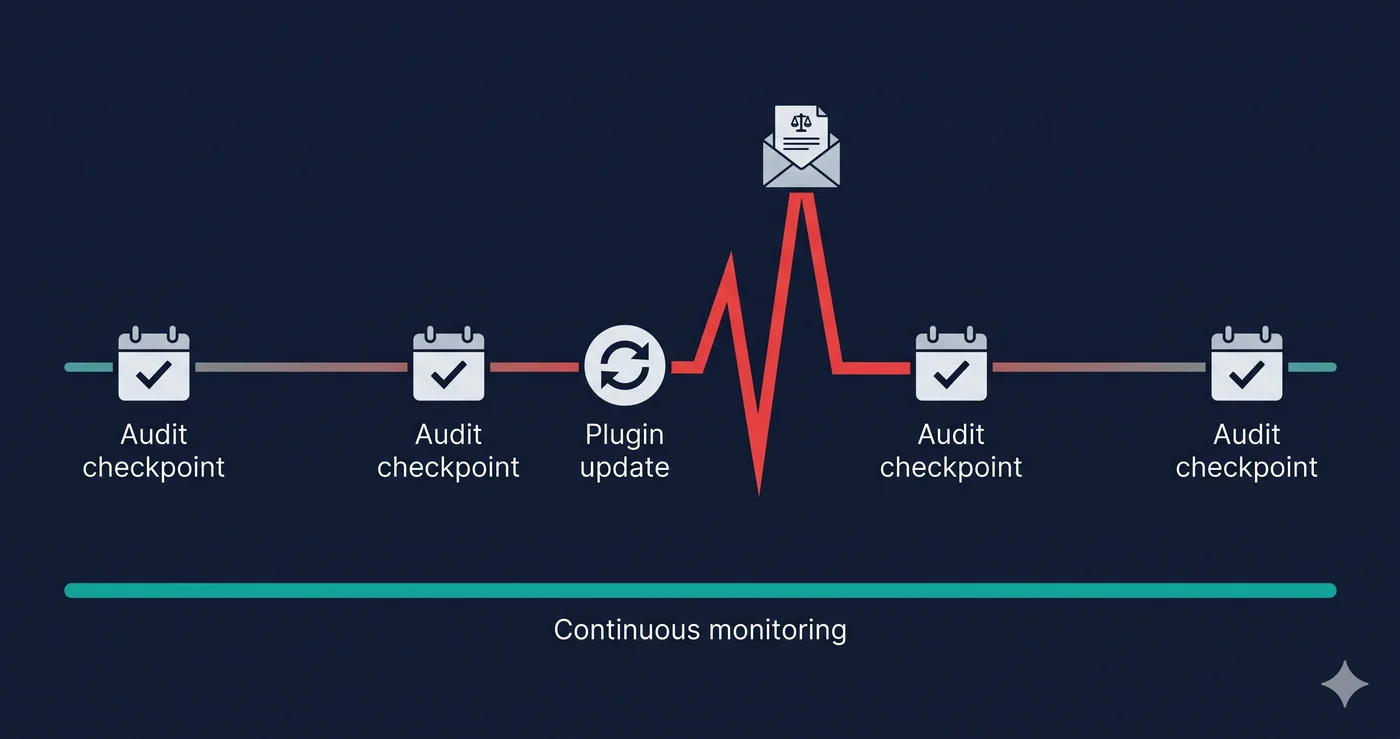
1,427 businesses sued for ADA web accessibility violations in 2025 had already been sued before (UsableNet). They settled the first lawsuit. They presumably made changes. They got sued again. The problem wasn't that they failed to act — it's that point-in-time testing treats accessibility like a one-time project, when websites change constantly.
Over 4,800 ADA website lawsuits were filed in 2025, a significant year-over-year increase (UsableNet). The businesses most at risk in 2026 aren't those that have never tested — they're those that tested once, fixed what they found, and assumed the problem was solved. An ada compliance testing tool used as a recurring scanner rather than a one-time audit is the difference between catching a violation before a plaintiff does and settling the same category of claim for the second time.
Why Websites Lose Their Accessibility Status After You Fix It
Fixing accessibility violations is not like painting a wall. A freshly painted wall stays painted. A freshly remediated website starts regressing the moment your next content update ships.
Third-party plugin updates. Every Shopify app, WordPress plugin, CMS widget, and embedded third-party tool on your site makes its own code updates on its own schedule. A live chat widget that passed your WCAG audit in January may push an update in March that changes its modal's focus management, removes keyboard-accessible close controls, or introduces a color contrast regression. You didn't change anything. The widget did. Your site now fails.
Template and theme updates. Platform theme updates frequently affect heading hierarchy, link text, button labels, and focus styles across the entire store. A WooCommerce theme update that adjusts H2 styling can silently break heading structure on every product page simultaneously.
New content. Marketing teams upload images without alt text. Blog posts use generic anchor text. Landing pages get built from templates with accessibility assumptions baked in that don't apply to the new content. Every content update is a potential regression.
Product catalog changes. New products mean new images, new product descriptions, new buttons, and new form fields. Each one can introduce violations that weren't present before.
Platform migrations. Moving from one payment processor to another, switching email marketing platforms, or adding a new review widget replaces accessible components with potentially inaccessible ones.
The Cost Structure of ADA Repeat Lawsuits
| Scenario | Typical Cost |
|---|---|
| First ADA demand letter — settle quickly | $5,000–$15,000 |
| First ADA demand letter — litigate to settlement | $25,000–$75,000 |
| First ADA lawsuit — litigate to judgment | $75,000–$250,000 |
| Second ADA lawsuit (same site, new violations) | $25,000–$100,000 |
| Second ADA lawsuit (same violations as first) | Higher — shows willful ignorance |
| Ongoing monitoring for 1–3 years (settlement requirement) | Already part of ADA settlements |
| ADAGuard professional plan (annual) | $1,290/year |
| Siteimprove comparable plan (annual) | ~$28,000/year |
The last two rows are not a hypothetical comparison. ADA settlements frequently require defendants to implement ongoing accessibility monitoring as a condition of settlement — meaning the monitoring cost gets mandated retroactively after a lawsuit, rather than chosen proactively before one.
When the cost of compliance monitoring is $1,290/year and the cost of a single settlement starts at $5,000, the economics of point-in-time testing don't hold. Quarterly audits cost less upfront, but each gap between audits is a window where a regression can exist, be found by a plaintiff, and become the basis of a new demand letter.
What "Continuous" ADA Compliance Testing Actually Means
Continuous compliance monitoring is not the same as running an ada compliance testing tool manually every month. It's an automated pipeline:
Automated scheduled scans — A website accessibility checker runs on your production site on a defined cadence (weekly, daily, or triggered by deployments) and flags new violations when they appear. You get an alert when something breaks, not a surprise from a plaintiff.
Coverage that matches your site's complexity — A scanner must cover your actual content — not just your homepage. Product pages, category pages, blog posts, checkout flows, account dashboards, and any page linked from your main navigation should be in scope.
Authenticated scanning — If your highest-risk content (checkout, account portal, subscription management) is behind a login, your ada compliance testing tool needs to authenticate and scan those flows. Public-only scans miss the content that's most likely to generate complaints.
Diff-based alerting — The most useful form of continuous testing flags new violations that appeared since the last scan — not just a list of every issue that exists. If your October scan passes and your November scan fails, you want to know what changed, not reread the full report.
Integration with your deployment pipeline — Advanced teams integrate accessibility scanning into CI/CD, failing builds that introduce new violations before they ever reach production. This catches regressions at the source rather than in production.
What the Rise in ADA Lawsuits Means for Testing Frequency
ADA website lawsuits grew significantly year-over-year in 2025 (UsableNet). The growth isn't driven by new legislation — it's driven by more plaintiff firms using more sophisticated automated scanners to identify targets faster. The tools used to find targets are getting better. The question is whether your ada compliance testing tool is keeping pace.
Plaintiff scanning doesn't run quarterly. It runs continuously. Plaintiff-side scanners crawl publicly accessible sites looking for specific violations — unlabeled buttons, missing form labels, empty links — and generate demand letters when they find them. The gap between when a violation is introduced by a plugin update and when a plaintiff finds it can be days, not months.
Quarterly audits were appropriate when plaintiffs used manual testing methods. They're not appropriate when plaintiffs use automated scanners.
The Continuous Compliance Workflow
For businesses, the practical framework:
-
Baseline scan — Run a full ada compliance testing tool scan across your site to identify and prioritize current violations. Fix critical issues (form labels, keyboard traps, missing alt text) first.
-
Rescan after fixes — Verify every remediation resolves the original violation before closing it.
-
Schedule recurring scans — Set up weekly or monthly automated scans. Treat accessibility violations like security vulnerabilities: flag them when they appear, assign them for remediation, verify the fix.
-
Scope beyond the homepage — Include product pages, category pages, blog posts, and checkout flows. High-traffic pages with frequent content updates are the highest-risk for undetected regressions.
-
Include authenticated pages — If you have any account-gated content, ensure your ada compliance testing tool can authenticate and scan it. ADAGuard supports authenticated scanning for logged-in flows on all paid plans.
-
Document your monitoring — Maintain records of scan dates, violation counts, remediation actions, and rescan confirmation. In the event of a demand letter, documented ongoing monitoring is a meaningful part of your legal defense.
Which Industries Are Most Exposed to Repeat Lawsuits
E-commerce accounted for approximately 70% of all ADA web accessibility lawsuits in 2025, according to UsableNet. The reason isn't that e-commerce businesses are more negligent — it's that e-commerce sites change more frequently. New products, seasonal promotions, app integrations, and checkout optimizations mean constant code changes, and constant code changes mean constant regression risk.
Food and service businesses made up approximately 21% of filings. Healthcare and financial services organizations are increasingly targeted as their Section 504 and ADA Title III exposure becomes clearer.
The 36% of defendants in 2025 with annual revenue above $25 million reflects the reality that larger businesses are disproportionately targeted because they have the resources to pay settlements.
The 30-Second Fix
Run a free scan at adaguard.io — no signup required. ADAGuard's ada compliance checker scans your full site across 23 automated check categories, covering approximately 78% of WCAG 2.2 AA criteria. It finds what point-in-time audits miss, what plugin updates break, and what your last quarterly review didn't catch.
The first scan is free. The question is whether you find your violations before the next demand letter does.