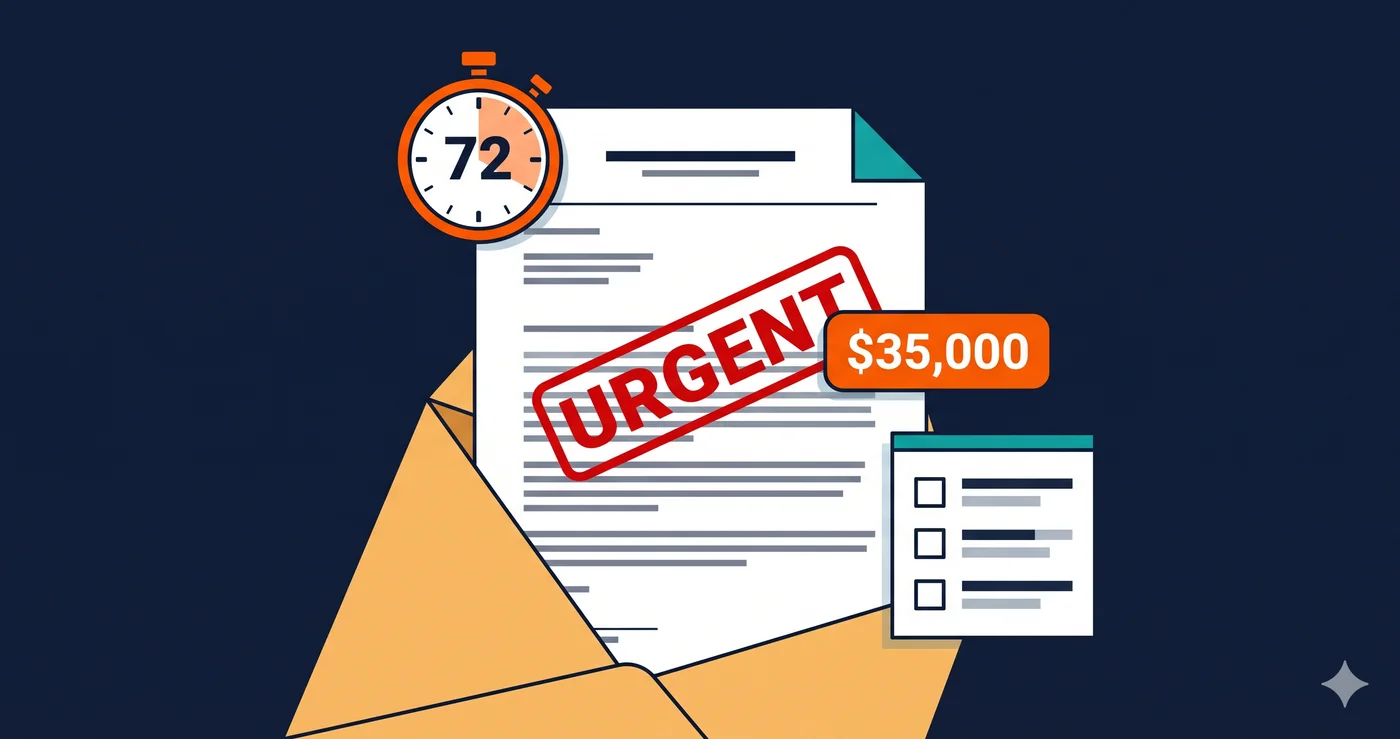
A letter arrives on Tuesday. The return address is a law firm in New York or Florida you have never heard of. The subject line references Title III of the Americans with Disabilities Act. Your website, the letter says, contains barriers that prevent users with disabilities from accessing your services. You have a short window to respond before litigation begins.
This is not a hypothetical. Between 35,000 and 50,000 ADA demand letters were sent to US businesses in 2025 — roughly 7 to 10 for every formal federal lawsuit filed (UsableNet, WCAGsafe). Demand letters outnumber federal court filings by a wide margin because they are cheaper for plaintiffs' attorneys to send, and most businesses settle quickly to avoid the cost of litigation. The business receives a letter, pays a settlement of $5,000 to $20,000, and agrees to remediation. The law firm moves on to the next target.
Understanding which industries receive the most ADA demand letters — and what specific elements trigger them — is the first step to understanding your own exposure.
The Industry Breakdown: Where Demand Letters Land
E-commerce and online retail is the single most targeted category by a significant margin. In the first half of 2025, 69% of all digital accessibility lawsuits targeted e-commerce businesses (UsableNet 2025 Mid-Year Report). The pattern is consistent: plaintiffs' attorneys use automated scanners to identify accessibility violations on retail websites, then send batch demand letters to multiple businesses with the same identified violations.
Food, restaurant, and beverage is the second most targeted sector, accounting for approximately 21% of web accessibility lawsuits (UsableNet, 2025). Restaurant websites are particularly vulnerable because they typically have limited development budgets, rely on templated designs, and contain specific high-risk elements: online ordering flows, PDF menus that are inaccessible to screen readers, location maps without accessible alternatives, and reservation widgets from third-party services.
Fashion and apparel rounds out the top three most targeted categories. Apparel e-commerce sites carry high litigation risk because of their heavy reliance on imagery, product variant selectors, size guides, and fit recommendation tools — each of which is a common source of WCAG violations.
In 2025, over 4,800 ADA web accessibility lawsuits were filed in US federal courts — a significant year-over-year increase (UsableNet). The majority of defendants were companies with annual revenues under $25 million, though the share of suits targeting larger companies is growing: 36% of defendants in the first half of 2025 had revenues above $25 million, up from 33% in 2024.
What the Demand Letter Actually Targets
ADA demand letters are not random. They follow a consistent pattern: an automated scanner identifies specific, easily documentable WCAG violations, and a template letter is generated citing those violations by technical name. The most common violations cited in demand letters are:
Missing alternative text on images (WCAG 1.1.1) — the most frequently cited violation across all industries
Inaccessible online ordering or checkout flows — missing form labels, unlabeled buttons, keyboard traps
PDF menus and documents that are not tagged or screen-reader accessible
Missing skip navigation links — forcing screen reader users to navigate through every header element on every page
Color contrast failures — particularly in call-to-action buttons and body text
Inaccessible pop-ups and modals — chat widgets, subscription prompts, and cart drawers that trap keyboard focus
The technical profile of a demand letter target looks like this: a business with a visually appealing, professionally designed website that was built without ever running a DOM-level accessibility scan. The violations are structural, not cosmetic, and they are not visible to sighted users browsing with a mouse.
Industry Risk Profile
Industry
Share of ADA Web Lawsuits
Primary Violation Types
Average Settlement Range
E-commerce / Online Retail
~69%
Alt text, form labels, cart/checkout flow
$15,000 – $75,000
Food, Restaurant, Beverage
~21%
PDF menus, ordering widgets, location maps
$10,000 – $45,000
Fashion and Apparel
High within e-commerce
Product imagery, size guides, variant selectors
$15,000 – $60,000
Healthcare
~2-3%
Patient portals, appointment forms
$20,000 – $80,000
Travel and Hospitality
Growing
Booking widgets, search filters
$15,000 – $60,000
Financial Services
Growing
Account dashboards, form flows
$25,000 – $100,000
Education
Established
Course platforms, document accessibility
$20,000 – $75,000
The Demand Letter Business Model
Understanding why certain industries are targeted more than others requires understanding how ADA demand letter litigation works as a business model.
Plaintiffs' attorneys use automated accessibility scanning tools to crawl thousands of websites and identify those with documentable WCAG violations. They prioritize industries with high transaction volumes — meaning websites where the inability to complete a purchase or booking creates a clear "denial of service" narrative. E-commerce, food delivery, and fashion retail all fit this profile perfectly.
The letters are batch-produced. One attorney or law firm may send hundreds of nearly identical letters in the same week, each customized with the target business name and the specific violations found on their site. The expectation is that a significant percentage will settle quickly, making the letter campaign financially productive before a single lawsuit is filed.
This is why demand letters outnumber lawsuits by 7 to 10 to one. The goal is not litigation — it is settlement. And settlement is most likely when a business:
Has no existing accessibility scan on file to counter the claims
Does not understand whether the cited violations are accurate
Calculates that the cost of defending a lawsuit exceeds the cost of settling
Why "We've Never Had a Complaint" Is Not a Defense
A demand letter does not follow a user complaint. It follows an automated scan. The business does not receive a call from a frustrated screen reader user before the letter arrives. There is no warning period, no complaint process, no regulatory notice. The letter is the notice.
This means that businesses with no history of accessibility complaints are not necessarily lower risk — they may simply not have been scanned yet. Plaintiffs' attorneys scan by industry and by geography, targeting clusters of similar businesses in the same category during concentrated filing periods. Restaurant chains in a particular metro area may receive letters in the same week. Shopify-based apparel brands in a specific revenue range may be targeted as a batch.
ADAGuard's website accessibility checker runs a full DOM-level scan that identifies the same violation types that automated plaintiff scanning tools document in demand letters. Running a scan before you receive a letter gives you three things: a compliance baseline, a prioritized remediation list, and documented evidence of good-faith compliance effort — all of which matter in any subsequent legal proceeding.
What to Do When You Receive a Demand Letter
If a demand letter has already arrived, the first step before any response or settlement is to verify whether the cited violations actually exist on your site. Demand letters occasionally cite violations that are inaccurate or refer to elements that have already been fixed. A current DOM-level ADAGuard scan gives you an independent compliance assessment to compare against the letter's claims.
For businesses that have not yet received a letter: the industries at highest risk are e-commerce, food service, and apparel. If your business falls into any of these categories and you have never run a live accessibility scan, you have no visibility into the violation profile that an automated plaintiff scanner would find on your site.
The 30-Second Fix
Between 35,000 and 50,000 ADA demand letters were sent in 2025. The businesses that received them had websites that looked fine and had never been flagged by any complaint. Run a free scan at adaguard.io — no signup required — and find out what a plaintiff's scanning tool would find on your site right now. ADAGuard evaluates 50+ WCAG criteria on your live, JavaScript-rendered page and shows you exactly which violations put your business in the highest-risk categories.