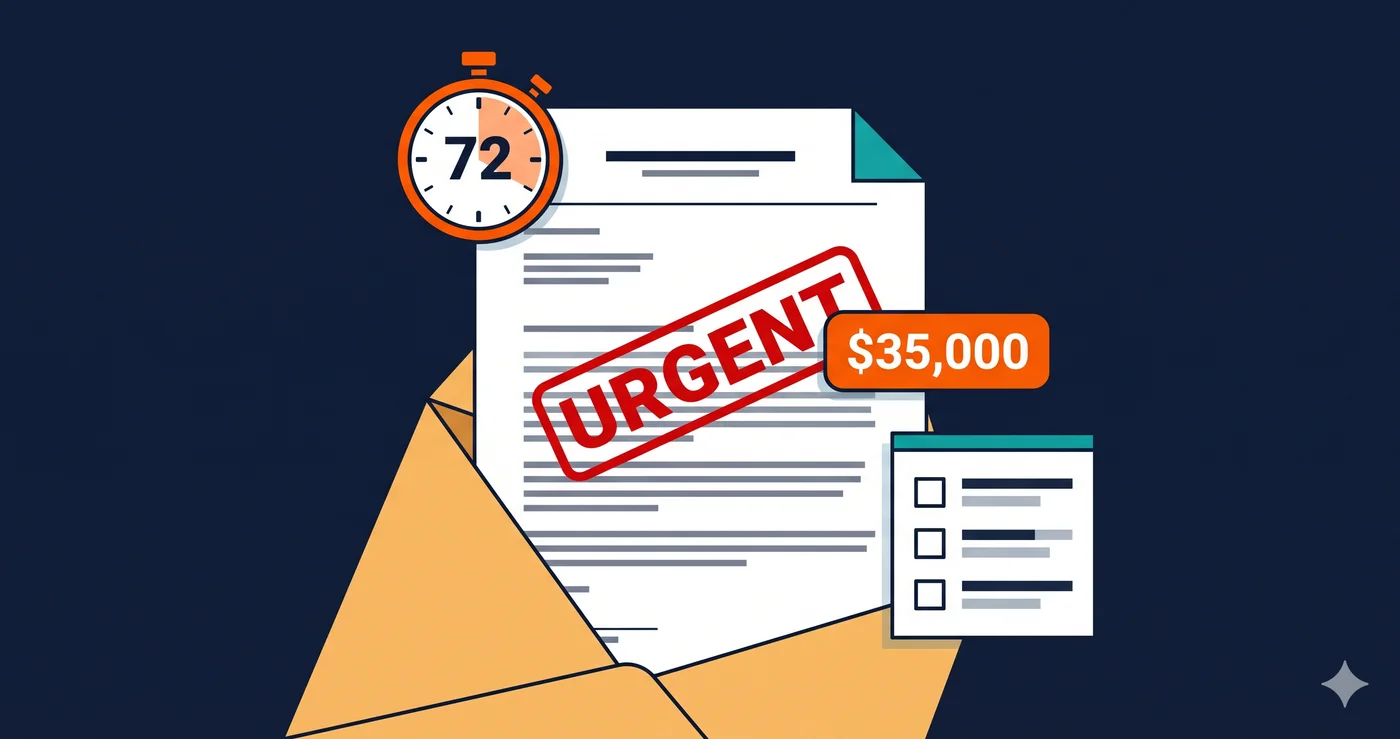
The letter arrives before you have ever run a free ada compliance checker on your site. A firm you have never heard of has documented specific violations — a form input without a label, a button without an accessible name, product images with no alt text — and they want $35,000 to make the lawsuit go away.
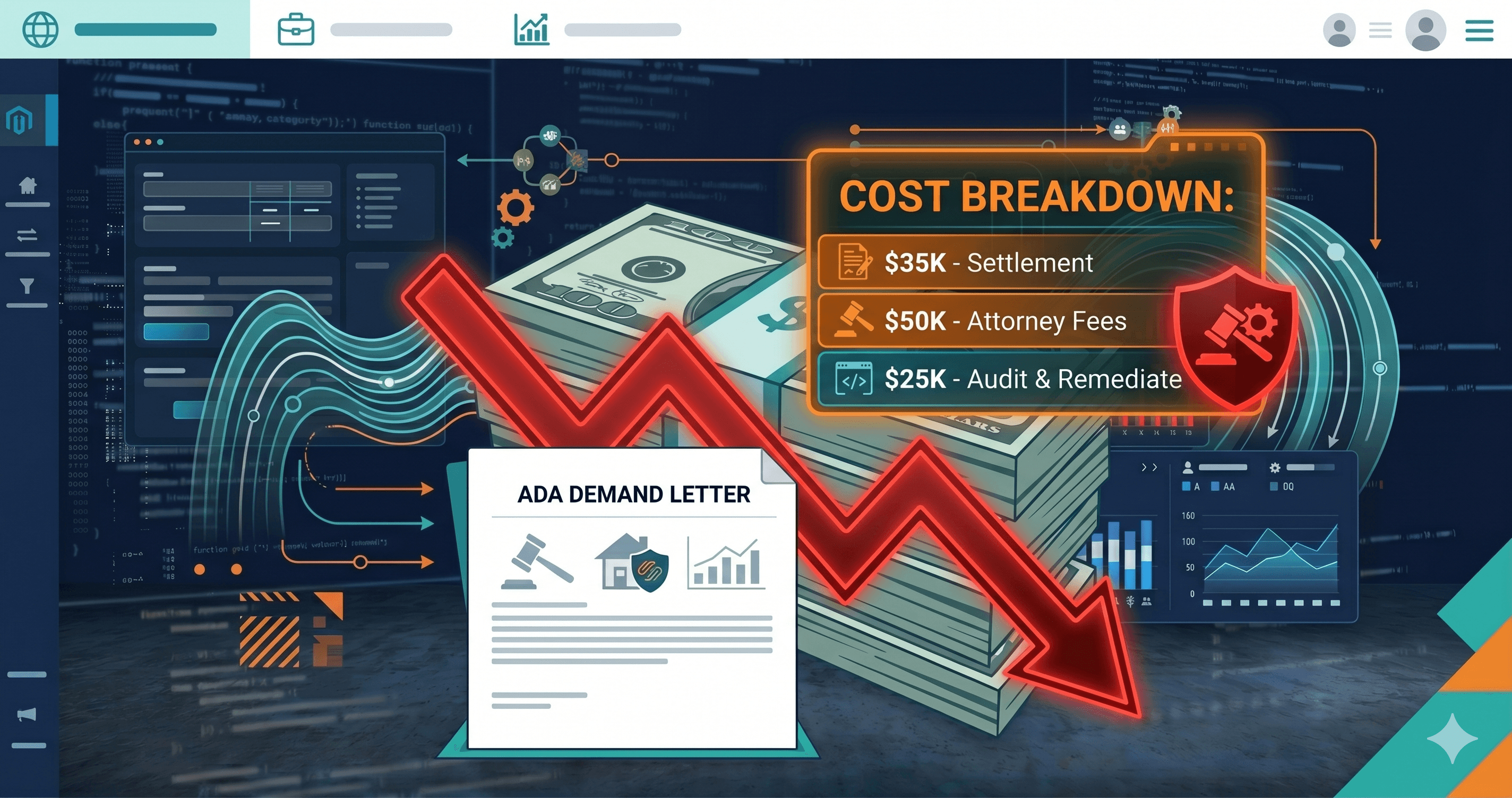
Most business owners believe the demand amount is the total cost. It is not. Over 4,800 ADA web accessibility lawsuits were filed in US courts in 2025 — a significant increase according to UsableNet — and for small and mid-sized eCommerce businesses, the total cost of resolving an ADA claim extends far beyond the settlement check. Defense attorneys, accessibility expert witnesses, mandatory remediation audits, court-supervised monitoring requirements: a case that settles on paper for $35,000 reliably costs $80,000–$120,000 by the time it's fully resolved.
The businesses that pay the most aren't those with the most violations. They're the ones that didn't know what their violations were before an attorney did.
The Complete Cost Structure of an ADA Lawsuit
Settlement amounts get the headlines. They represent only one component of the total financial exposure. Here is what resolving an ADA website accessibility claim actually costs for a mid-sized eCommerce business in 2026:
| Cost Component | Low Estimate | High Estimate | Notes |
|---|
| Demand letter settlement (pre-litigation) | $3,000 | $25,000 | Fastest resolution |
| Out-of-court settlement (post-filing) | $25,000 | $75,000 | Most common outcome |
| Litigation judgment | $75,000 | $150,000+ | Rare but catastrophic for SMBs |
| Defense attorney fees | $10,000 | $50,000 | Required even for settlements |
| Accessibility expert witness | $5,000 | $20,000 | Standard in negotiated consent decrees |
| Court-ordered third-party remediation audit | $5,000 | $25,000 | Required in most consent decrees |
| Website remediation and development costs | $10,000 | $100,000 | Depends on scope of violations |
| Ongoing monitoring requirements (2–3 years) | $5,000 | $30,000 | Stipulated in most consent decrees |
| Total exposure (typical resolved case) | $35,000 | $200,000+ | — |
Sources: Accessible.org, TestParty, WebAbility.io, WCAGsafe (2026 settlement data).
The $35,000 floor reflects what a mid-market eCommerce operator typically pays when they receive a demand letter and resolve it outside formal litigation: paying the settlement demand, engaging defense counsel to evaluate and negotiate terms, commissioning a third-party accessibility audit as required by the consent decree, and completing the mandated site fixes. It does not include cases that proceed to discovery or trial, where total costs reliably exceed $100,000.
Why Ignorance Costs the Most
Courts and plaintiffs in ADA accessibility cases consistently consider the defendant's prior accessibility awareness. Businesses with no history of accessibility scanning, no documented remediation efforts, and no accessibility statement face settlement negotiations from a structurally weaker position than businesses that have run regular audits, tracked violations, and documented remediation progress.
The difference is not just ethical — it's financial. Defendants who can demonstrate a good-faith accessibility program negotiate shorter monitoring periods, smaller expert witness requirements, and more reasonable remediation timelines. Defendants with no prior record settle the same claim for more money under more demanding terms.
ADAGuard's scan reports are timestamped, violation-specific, and WCAG-criterion-referenced. Running monthly scans doesn't just reveal violations — it creates an ongoing record of accessibility awareness and remediation effort. That record has measurable value in a settlement negotiation.
The Trajectory Is Getting Steeper
The 2025 filing totals are alarming in isolation. In the context of the trend, they are more alarming:
Federal ADA website accessibility lawsuits increased from approximately 2,452 filings in 2024 to 3,117 in 2025 — a 27% increase in documented federal cases (ADA Title III). The UsableNet total of 4,800+ includes state court filings and represents a significant year-over-year increase.
Pro se filings — lawsuits filed without attorney representation, using AI tools to draft complaints — increased 40% in 2025 (ADA Title III). This expansion of who can file accessibility claims is not temporary. The AI tools that make complaint drafting accessible to individuals without legal training will only improve.
Illinois, which filed 28 ADA website cases in all of 2024, filed 237 in 2025 — a 746% increase (EcomBack), demonstrating that plaintiff firms are expanding into new jurisdictions rather than concentrating in established markets. Geographic "safety" based on a state's historically low litigation rate is no longer a reliable assessment.
The firms driving this activity are not going away. Manning Law, APC — responsible for over 14% of all federal ADA website filings in H1 2025 — operates at industrial scale and has no structural incentive to reduce its filing volume. The settlement economics remain favorable.
The Class Action Dimension
Individual ADA demand letters resolve in the tens of thousands. Class actions are a different magnitude. In 2025, a $5.15 million class action settlement was reached in a California ADA digital accessibility case — the largest digital accessibility settlement on record at the time (Accessible.org).
Class actions are rare in website accessibility litigation, but they target businesses where the same violation affects a large number of users simultaneously — which is precisely the scenario when a Shopify store with tens of thousands of customers has an inaccessible checkout flow. Every user who attempted to use a screen reader and could not complete a purchase is a potential class member.
The plaintiff bar has not yet aggressively pursued class certification against small eCommerce operators. The $5.15 million California settlement demonstrates that the legal framework exists, that courts will certify digital accessibility classes, and that the financial exposure scales with the size of the affected user base.
What Your Compliance Budget Actually Buys
The cost comparison between running an ada compliance checker and absorbing an ADA lawsuit is not subtle:
ADAGuard's Professional annual plan: $1,290/year — covers unlimited scans, monthly monitoring, and full 23-category DOM-level analysis.
Typical mid-market ADA lawsuit resolution: $60,000–$200,000 total — including settlement, attorney fees, expert witness, mandatory audit, remediation costs, and monitoring.
The ratio is approximately 40:1 to 130:1. For every dollar spent on proactive accessibility scanning and remediation, you are mitigating $40–$130 in potential lawsuit costs. This is not a compliance cost — it is risk management that happens to also improve your product.
Industries With the Highest Exposure
Not all eCommerce operators carry equal risk. The industries with the highest average settlement amounts are those with the most documented harm:
Retail eCommerce — representing 69–77% of all digital accessibility lawsuits — carries the highest volume. Settlement amounts for mid-market retailers typically run $25,000–$75,000 for single-plaintiff cases.
Financial services — banking portals, insurance platforms, investment tools — face higher average settlements because the harm of an inaccessible banking interface is high-value and clearly documentable. Financial services cases regularly exceed six figures.
Healthcare and telehealth — particularly patient portals and appointment scheduling systems — represent an emerging target category as digital health delivery scales. The combination of ADA exposure and HIPAA compliance obligations creates compounding legal risk.
What to Do Before a Letter Arrives
When a free ada compliance checker scan returns violations, the remediation priority should mirror the legal risk profile:
Fix checkout and cart violations first. These are the failures that most directly prevent a transaction — the harm demand letters document. Cart drawer focus failures, unlabeled checkout buttons, and missing form labels in the payment flow are the highest-priority remediation targets.
Document your remediation effort systematically. Save every scan report. Date every developer ticket. Record when you reported vendor violations. This documentation is worth thousands of dollars in settlement negotiation and can be the deciding factor in monitoring period length.
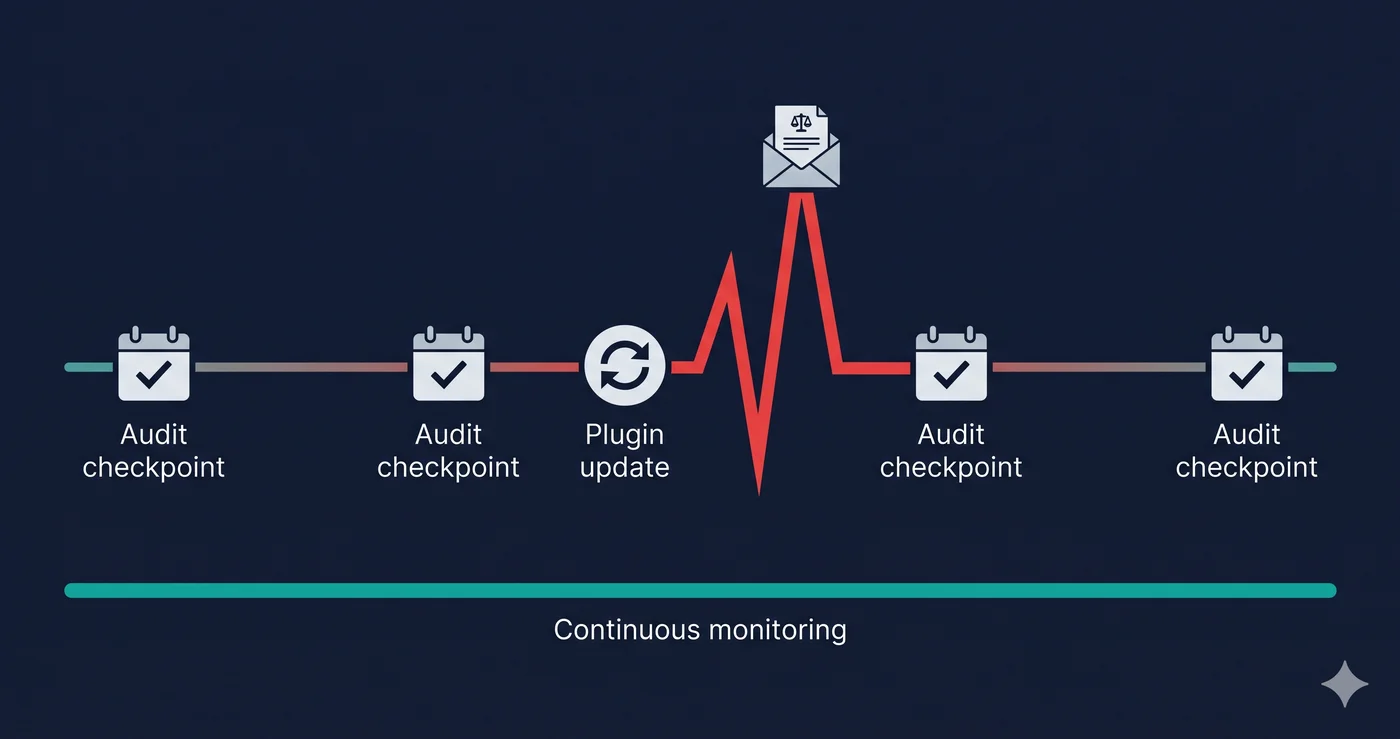
Scan after every significant site update. Theme updates, new app installations, and CMS changes can each introduce new violations. A scan schedule aligned with your deployment calendar ensures you are not discovering violations in an attorney's demand letter.
The 30-Second Fix
The cost of running a free ada compliance checker scan is zero. The cost of discovering your violations in a plaintiff attorney's demand letter is measured in five to six figures.
Paste your URL at adaguard.io — no sign-up required, instant results. ADAGuard's scanner runs 50+ accessibility checks across 23 categories against your fully-rendered DOM, covering approximately 78% of WCAG 2.2 AA automatically (43 of 55 criteria). The report tells you which violations you have, which WCAG criterion each violates, and how severe each is.
That report is worth having before someone else generates it for you.