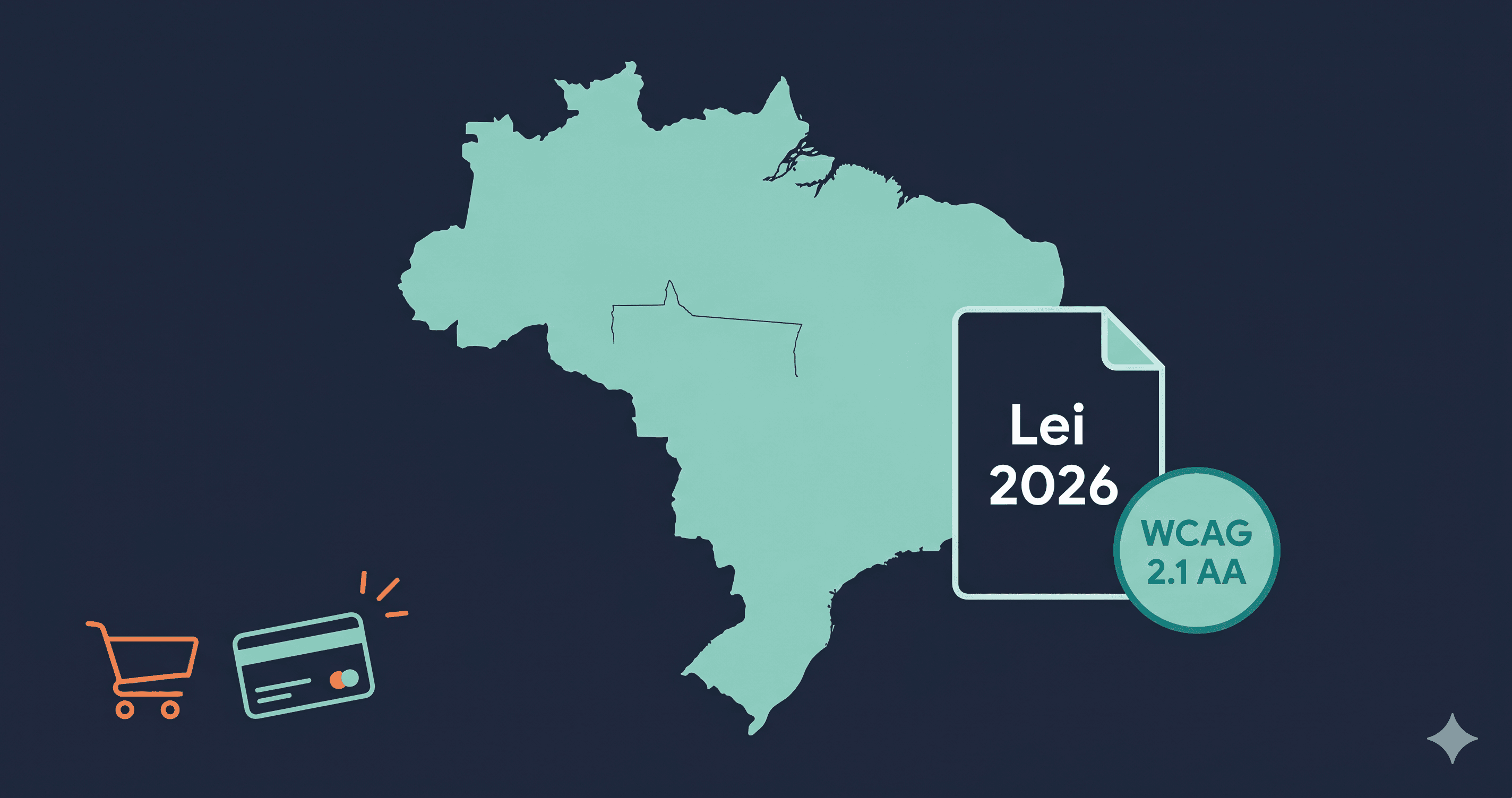
Brazil has over 215 million people, more than 75 million active e-commerce shoppers, and one of the fastest-growing fintech markets in the world. It also has a federal accessibility law — the Lei Brasileira de Inclusão (LBI) — that requires every public and private digital product and service to be accessible under WCAG-aligned standards. Enforcement focus on e-commerce and fintech has accelerated in 2025–2026, and international companies operating in Brazil are not exempt.
Brazil's disabled population is significant: approximately 18.6 million Brazilians have some form of disability (IBGE 2023 census data). That's nearly 9% of the population — a user segment that many digital businesses are simultaneously required to serve and actively excluding through inaccessible interfaces.
The LBI is not a future compliance deadline. It has been law since 2015. The question for e-commerce and fintech companies operating in Brazil is not whether the obligation exists — it does — but whether their digital products currently meet it.
What Is the LBI?
The Lei Brasileira de Inclusão das Pessoas com Deficiência (LBI) — Law No. 13,146/2015 — is Brazil's comprehensive statute on the rights of persons with disabilities. Chapter IV covers digital accessibility directly. Article 63 states that e-commerce websites and digital services must be made accessible to persons with disabilities, with compliance to internationally recognised accessibility guidelines.
The referenced standard is WCAG 2.0 and above, aligned with Brazil's eMAG (Modelo de Acessibilidade em Governo Eletrônico), the government's own accessibility model. eMAG incorporates WCAG principles and adds Brazilian-specific guidance on language, screen reader compatibility with popular Brazilian assistive technology, and Portuguese language content structure. In practice, WCAG 2.1 Level AA is the international benchmark most compliance frameworks in Brazil reference.
The LBI is enforced through multiple channels: Procon (consumer protection agencies at state and municipal level), the Secretaria Nacional dos Direitos da Pessoa com Deficiência (SNDPD), and civil litigation. Prosecutors can bring public civil actions against organisations that systematically exclude disabled users from digital services.
Who Must Comply
The LBI applies broadly:
E-commerce platforms: Any website or app selling goods or services to Brazilian consumers must be accessible. This includes international e-commerce operations with Brazilian customers. Brazilian consumer law — including the Código de Defesa do Consumidor — gives regulators tools to apply to cross-border digital commerce.
Financial services and fintech: Brazil's Central Bank (Banco Central do Brasil) has included digital accessibility in its regulatory framework for financial institutions, recognising that inaccessible banking interfaces create discriminatory barriers for disabled customers. Fintechs serving Brazilian consumers face sector-specific guidance alongside the LBI.
Digital platforms: Social media platforms, SaaS tools, streaming services, and any digital product used by Brazilian consumers falls within the LBI's scope for private-sector digital accessibility.
Government services: All federal, state, and municipal digital services are covered by both the LBI and eMAG requirements, with stronger enforcement in the public sector.
The WCAG Standards That Apply in Brazil
| Standard | Status in Brazil | Enforcement Channel |
|---|
| WCAG 2.0 Level A | Minimum — baseline LBI compliance | Procon, civil litigation |
| WCAG 2.0 Level AA | Recommended — standard compliance benchmark | Procon, SNDPD, civil litigation |
| WCAG 2.1 Level AA | Best practice — increasingly expected | Industry guidance, procurement requirements |
| eMAG | Government websites — mandatory | Federal and state digital government enforcement |
| WCAG 2.2 Level AA | Not yet formally required — forward-looking | Industry best practice |
The LBI's text references international standards rather than a specific WCAG version, which gives Brazilian courts and regulators flexibility to apply the most current WCAG level as the relevant benchmark. Legal advice in Brazil increasingly recommends targeting WCAG 2.1 AA for compliance purposes, particularly in e-commerce and fintech where consumer protection enforcement is most active.
E-Commerce: The Highest-Risk Category
Brazil's e-commerce market processed over R$185 billion in 2024 (ABComm data) — an industry large enough to attract significant regulatory attention to consumer rights violations. Accessibility failures in e-commerce fall into categories that Procon and civil courts find actionable: unlabelled checkout form fields that screen readers cannot interpret, product images without alternative text that blind users cannot perceive, and navigation structures that trap keyboard users in dropdown menus or modal dialogs.
The most common accessibility violations in Brazilian e-commerce platforms mirror global patterns: 83.9% of web pages globally have low contrast text (WebAIM 2026 Million), and Brazilian retail sites are no exception. Unlabelled form fields in the checkout process — the exact type of violation that triggers US ADA demand letters — are equally common in Brazil and equally problematic under the LBI.
For international e-commerce operators entering Brazil, the LBI adds a compliance requirement on top of their domestic obligations. A US-based retailer selling to Brazilian consumers needs to satisfy both US ADA standards and Brazil's LBI for their Brazilian-facing content. Running an accessibility scan with ADAGuard across your Brazil-facing product pages gives you a baseline WCAG 2.2 coverage picture regardless of jurisdiction.
Fintech: Sector-Specific Pressure
Brazil's financial sector is subject to Banco Central's Resolution No. 4,949/2021, which requires financial institutions to have digital accessibility policies for customers with disabilities. This resolution made digital accessibility a regulatory expectation for Brazilian banks and fintechs with formal reporting requirements.
For fintech startups serving Brazilian consumers, accessibility is not a bolt-on feature. Regulatory inspections by Banco Central can include assessment of digital inclusion — whether the institution's app and web platform are genuinely usable by customers with visual, hearing, motor, and cognitive disabilities. Fintechs that have built natively inaccessible platforms face both consumer litigation risk and regulatory examination findings.
The overlap with international e-commerce is significant: Brazilian Buy Now Pay Later providers, embedded checkout fintechs, and payment processors servicing international merchants in Brazil are subject to Banco Central oversight and the LBI simultaneously.
What Brazilian Enforcement Looks Like in 2026
Brazilian enforcement is primarily civil and complaint-driven rather than proactive government audit-driven. Procon agencies receive complaints from disabled consumers who cannot access digital services and can issue fines and require immediate remediation. The Ministério Público can bring public civil actions (ações civis públicas) seeking systemic accessibility fixes and compensation for affected classes of users.
In April 2026, Brazil's enforcement of the ECA Digital (Estatuto da Criança e do Adolescente Digital) began — a separate but illustrative example of Brazil's accelerating digital regulatory enforcement. The trajectory across digital regulation in Brazil is toward more, not less, enforcement. Digital accessibility is one of the areas where civil society organisations and disability rights groups have been building litigation capacity.
The Advocacia-Geral da União (AGU) and state-level public defenders have brought accessibility-related cases against major retailers and public services. Civil settlements in accessibility cases typically require a remediation timeline, third-party auditing, and compensation to affected users.
What to Do When You Find Violations
A Brazilian LBI compliance programme starts the same way as any accessibility programme: with a current scan of your digital properties. Run your e-commerce or fintech URL through ADAGuard for a free WCAG 2.2 AA scan. ADAGuard covers 22 custom checker categories plus axe-core integration across 50+ checks — providing ~78% automated coverage of WCAG 2.2 AA criteria.
For Brazilian operations specifically, review your scan results against four high-priority categories: form label compliance (critical for checkout and account registration flows), colour contrast (affects low-vision users navigating your product pages), keyboard navigation (affects motor-impaired users completing transactions), and ARIA label quality (affects screen reader users — particularly relevant given JAWS and NVDA usage patterns among Brazilian blind users).
Violations in your own codebase go to your development team with the WCAG criterion number as the ticket reference. Violations in third-party components — payment widgets, product review tools, live chat systems — require vendor tickets citing the specific failure. Document both, because Brazilian consumer protection proceedings can examine whether you took steps to identify and address accessibility barriers.
For fintech companies under Banco Central oversight, a documented accessibility programme — scan reports, remediation priorities, vendor tickets, progress tracking — is the kind of evidence that supports a positive examination outcome. Regulators are assessing whether institutions have accessibility processes, not just whether every element is perfect today.
The 30-Second Fix
Brazil has over 215 million potential users, millions of them with disabilities who are legally entitled to access your digital product. Paste your e-commerce or fintech URL at adaguard.io for a free WCAG 2.2 AA scan. ADAGuard's ~78% automated WCAG 2.2 AA coverage gives you a realistic picture of your LBI compliance exposure in under 60 seconds. Start with a scan. Fix what you find. The LBI has been waiting since 2015.