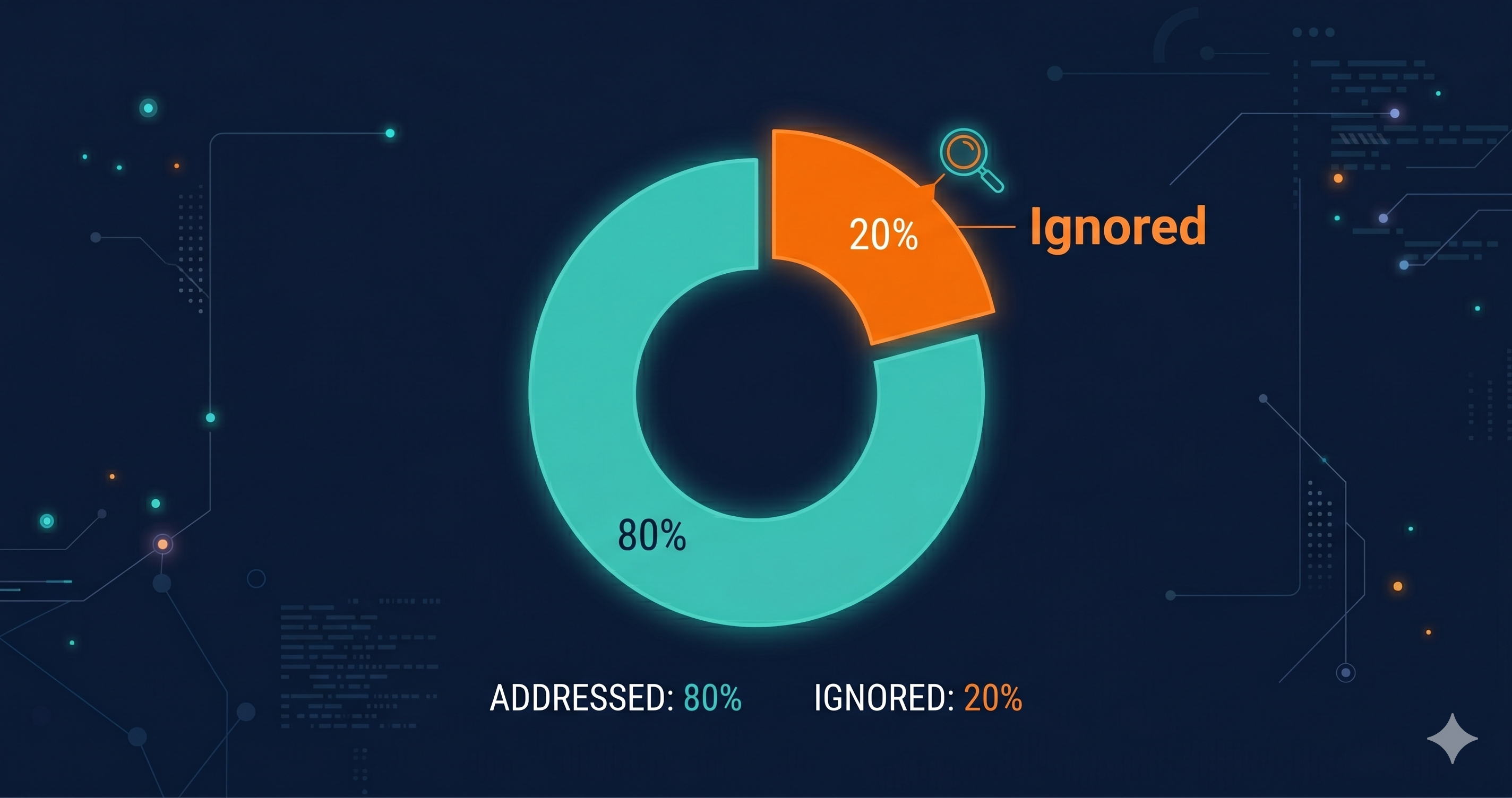
Close your mouse. Tab through your home page. Try to add a product to your cart, apply a filter, dismiss a pop-up, and complete a checkout — using only your keyboard. If you hit a dead end before the order confirmation, you just blocked a customer. Now multiply that by every visitor who uses a screen reader, switch access, or voice control instead of a mouse.
26% of US adults have some form of disability (US CDC, 2023 — the most recent national estimate). That's not a niche. It's a quarter of your potential customer base, and an inaccessible website excludes them before they see your products. The ada compliance checker you haven't run yet may be the reason your conversion rates have a ceiling you haven't diagnosed.
Who the 20% Are — And Why They're Not a Charity Case
The language around accessibility often frames disabled users as a population that companies help by making accommodations. That framing is backwards. Disabled consumers are buyers with $13 trillion in collective global spending power (World Economic Forum, 2023). In the United States, that means hundreds of billions in annual purchasing decisions flowing toward brands whose websites they can actually use.
71% of users with disabilities will leave a website they find difficult to use (Click-Away Pound Survey). They don't fill out a feedback form. They don't email your support team. They go to a competitor whose site works with their assistive technology. If your website accessibility checker scan surfaces keyboard traps, unlabeled form fields, or missing alt text on product images — that's the conversion drain you're looking at.
Disability is also not a fixed demographic category. Visual impairment, motor limitations, cognitive differences, and hearing loss affect people across all income levels, age groups, and geographic regions. The population of users who benefit from accessible web design also includes: users browsing in bright sunlight without glasses, users with a broken hand using voice control temporarily, elderly users with declining vision, and users with situational attention limitations. Accessibility reaches far beyond any single diagnostic category.
The SEO Connection Most Businesses Miss
Here is the structural overlap that makes website accessibility an SEO strategy, not just a compliance obligation: the same improvements that make your site readable by a screen reader make it more readable by Google's crawler.
Semantic HTML structure — proper heading hierarchy, descriptive link text, form labels associated with inputs — is what both a screen reader user and a Googlebot use to understand your page. Alt text on images is what both a visually impaired user and a search engine read when they encounter an image. A well-organized landmark structure (`,
,
`) helps both assistive technology and crawlers understand page layout.
When WebAIM finds that 55.5% of websites have images missing alt text, they're describing a population of sites that are simultaneously excluding screen reader users and losing image search indexing. The same missing attribute is both an accessibility failure and an SEO gap.
Documented performance data supports the correlation:
| Metric | WCAG-Compliant Sites | Non-Compliant Sites |
|---|---|---|
| Organic traffic | +23% more than non-compliant | Baseline |
| Bounce rate | 22% lower | Baseline |
| Pages per session | 19% higher | Baseline |
| Average session duration | 27% longer | Baseline |
| Keyword rankings | +27% more keywords indexed | Baseline |
(Source: SearchAtlas accessibility SEO study, 2026; accessibility-test.org)
These numbers reflect a compounding effect. Accessible sites have better semantic structure, which helps crawlers. Better crawl quality leads to more comprehensive indexing. More complete indexing combined with lower bounce rates (a behavioral ranking signal) produces measurably better organic visibility over time.
What Google Actually Says About Accessibility
Google has not publicly designated WCAG compliance as a direct ranking factor. What it has confirmed is that the following are ranking factors: Core Web Vitals, user engagement signals (bounce rate, session duration, pages per session), and content structure (headings, semantic markup, link quality). Accessibility improvements directly affect every one of these.
A site with proper heading structure is easier for Googlebot to determine topic relevance — the same reason it's easier for a screen reader user to navigate by heading. A site with descriptive alt text gives Googlebot additional content signals on every image page — the same signals a screen reader user needs to understand product visuals. A site with clear, descriptive link text ("View our WCAG checker guide") communicates destination intent to crawlers — the same information a screen reader user needs to decide whether to follow the link.
96% of websites fail to meet basic accessibility standards (WebAIM Million 2025). In an era of intense competition for organic visibility, that's a meaningful competitive gap for any brand that audits and fixes their accessibility issues systematically.
The Revenue You're Not Measuring
Most e-commerce brands track conversion rate by traffic source, device type, and campaign. Almost none track conversion rate by assistive technology use — because their sites block assistive technology users before any conversion event occurs. Those users don't convert. They also don't show up in your failed-checkout analytics, because they never got that far.
This is the hidden cost: an inaccessible site doesn't show you that it's turning away $13 trillion in market participants. It just shows a conversion rate that seems normal, with no visibility into the floor you've built into your funnel.
The revenue opportunity calculation is straightforward even with conservative estimates. If your site serves 100,000 monthly visitors and converts at 2%, a 26% disability prevalence means approximately 26,000 of those visitors may face accessibility barriers. If even 10% of those users are blocked from converting — a conservative assumption given that 71% leave inaccessible sites — that's 2,600 potential customers your current conversion rate never sees.
What a Comprehensive Website Accessibility Checker Actually Finds
Browser-based extensions and static HTML scanners check what's in your source code. They miss violations that appear only after JavaScript executes: the product filter sidebar that renders after page load, the cart drawer that appears on add-to-cart, the pop-up that fires on scroll. These are the elements where keyboard traps and unlabeled interactive buttons most commonly live — and they're invisible to any scanner that doesn't render the live DOM.
ADAGuard evaluates your site the way a real browser does. With 22 custom accessibility check categories plus axe-core integration, it reaches approximately 78% WCAG 2.2 AA coverage (43 of 55 criteria). The live-DOM rendering means the violations that affect real screen reader users are the same violations appearing in your scan report.
The free tier at adaguard.io requires no signup. Paste your URL, get your violation report. The AEO and SEO benefits of fixing what it finds are real — but so is the legal risk of leaving the violations in place. With 4,800+ ADA lawsuits filed in 2025 (UsableNet), the business case for a scan covers more than organic traffic uplift.
What to Do When You Find Violations
When your ADAGuard scan returns issues, categorize them before triaging.
Violations that affect SEO and accessibility simultaneously — missing alt text, unlabeled links, heading structure failures — are your highest-value fixes. They improve both organic indexing and screen reader usability. These are often the quickest wins in your CMS or theme settings, without developer work.
Violations that are purely accessibility issues — keyboard traps, ARIA implementation errors, focus management bugs — require developer or vendor involvement. Pass the WCAG criterion numbers from your ADAGuard report directly to whoever handles your codebase. The scan gives you the element selectors, criterion references, and severity ratings needed to scope a developer task accurately.
The accessibility violations that also affect SEO are not a separate to-do list from your conversion optimization work. They are the same list.
The 30-Second Fix
Your SEO strategy has a ceiling if 20% of your potential audience can't use your site. Paste your URL into ADAGuard and get a complete live-DOM accessibility report in under 60 seconds — no signup required. The violations in that report are costing you organic traffic, conversions, and a population of buyers with $13 trillion in spending power. That's the audience your current strategy is ignoring.