In the first six months of 2025, just 16 law firms filed more than 90% of all ADA website accessibility lawsuits in the United States. These firms weren't pursuing isolated discrimination cases. They were running industrial-scale enforcement campaigns against thousands of eCommerce stores simultaneously, using the same automated accessibility scanners that are available to anyone — including you.
Over 4,800 ADA web accessibility lawsuits were filed in 2025 — a significant year-over-year increase according to UsableNet. The overwhelming majority didn't begin with a disabled user independently discovering an inaccessible website and contacting an attorney. They began with a law firm running an ada compliance checker against a list of thousands of sites and filing complaints for every one that returned a match.
How Serial Plaintiff Campaigns Operate
The business model is methodical. Plaintiff law firms acquire or generate lists of eCommerce sites, run automated accessibility scans against each one, and route sites with detectable WCAG violations to a pool of named plaintiffs — individuals with documented disabilities who regularly work with these firms. The plaintiff becomes the named party in hundreds or thousands of lawsuits filed over the course of a year. The firm collects settlement fees at scale.
The economics work because most defendants settle quickly. A small eCommerce operator receiving a $15,000–$25,000 demand letter faces a calculation that plaintiff firms understand precisely: the cost of hiring a lawyer to evaluate whether the claim is valid often approaches the demand amount itself. Most businesses pay the settlement and agree to remediation terms. The firm moves to the next site on its scanning list.
Manning Law, APC was the leading filer in the first half of 2025, responsible for over 14% of all ADA website accessibility lawsuits nationwide during that period (EcomBack 2025 Mid-Year Report). Gottlieb & Associates and Equal Access Law Group each filed more than 200 cases in the same six months. These aren't small civil rights practices pursuing individual cases — they're operating automated legal pipelines at a volume most businesses can't comprehend.
eCommerce Is the Primary Target
The concentration of ADA website lawsuits in eCommerce is not incidental. eCommerce and retail represent approximately 69–77% of all ADA web accessibility lawsuits filed annually (UsableNet). The sector dominates for a legally logical reason: websites are the primary channel through which customers interact with eCommerce businesses, and an inaccessible checkout flow creates the kind of concrete, documentable harm that ADA Title III was designed to address.
The 2025 industry breakdown demonstrates this clearly:
| Industry Segment | Approx. Share of ADA Filings | Trend |
|---|
| Restaurants and food/beverage | ~34.6% (highest single category) | Growing |
| Retail eCommerce | ~25–30% | Growing |
| Entertainment and ticketing | ~8–12% | Stable |
| Financial services and banking | ~6–10% | Growing |
| Healthcare and wellness | ~5–8% | Growing |
Source: EcomBack 2025 Mid-Year ADA Website Lawsuit Report, UsableNet 2025 Annual Report.
Restaurants lead because they operate at the intersection of digital ordering, accessible menus, and reservation systems — high transaction volume, broad user base, and consistently poor accessibility across the category. Retail eCommerce follows because the harm of an inaccessible cart or checkout flow is both concrete (a user cannot complete a purchase) and documentable (the screen reader output captures exactly what the user experienced).
Why eCommerce Is the Preferred Legal Target
The legal logic for targeting eCommerce specifically rests on what courts have established about ADA Title III: that eCommerce websites are places of public accommodation, and that a blind user who cannot complete a checkout transaction has been denied the fundamental service the website exists to provide.
This is different from an accessibility failure on a corporate about page, where a user might find alternative contact methods. A non-functional cart drawer for a screen reader user means no purchase is possible — period. That directness makes eCommerce targets easy to litigate and easy to settle. Plaintiff firms know that the harm is straightforward to document and that defendants understand it.
The compounding factor is volume. With hundreds of thousands of Shopify stores and millions of independent eCommerce sites operating in the US, the pool of potentially non-compliant targets is enormous. WebAIM's 2026 analysis found that Shopping category websites averaged 71 accessibility errors per page — 26.6% above the web-wide average of 56.1 errors. Shopify-powered stores specifically averaged 75.1 errors per page. The scanning list that plaintiff firms work through is not running short.
The Pro Se Surge: The Barrier to Litigation Is Dropping
One of the more alarming developments in 2025 was a sharp rise in pro se ADA website filings — lawsuits filed by individuals without legal representation, using AI tools including ChatGPT, Copilot, and Gemini to draft legally sufficient complaints (ADA Title III). Previously, you needed a plaintiff attorney to pursue an ADA website accessibility claim. Increasingly, any individual with a disability, a WCAG checker, and access to an AI writing tool can file their own complaint.
This development changes the risk calculus for eCommerce operators in a fundamental way. The pool of potential plaintiffs is no longer limited to the clients of 16 specialized law firms. It now includes any individual who can document a WCAG failure on your site and navigate an AI interface. The deterrent effect of "I'd need to find a law firm willing to take my case" is disappearing.
Geography Matters: New Jurisdictions Are Opening
ADA website lawsuits are not evenly distributed across the country. New York remained the most litigious state in 2025, accounting for 637 federal filings — 31.6% of the total. Florida nearly doubled its filing count to 487 cases (24.2%). California rose to 380 cases (18.9%).
The most striking trend was Illinois, which surged 746% year-over-year — from just 28 cases in 2024 to 237 in 2025 (EcomBack). This explosive growth in a previously quiet jurisdiction signals targeted expansion by plaintiff firms entering new markets. For eCommerce operators who had taken comfort in their state's historically low litigation rate, the Illinois data is a direct warning: jurisdictional "safety" is not a reliable long-term strategy.
What Serial Plaintiff Campaigns Actually Scan For
Serial plaintiff firms use the same automated scanning technology available to anyone — WAVE, axe-core, and purpose-built ada compliance checker tools — against the same WCAG criteria. The violations they document in demand letters correspond precisely to the most common automatically-detectable failures identified by WebAIM's 2026 Million report:
Empty buttons (30.6% of websites), missing form labels (51%), missing image alt text (53.1%), empty links (46.3%), and low contrast text (83.9%) account for 96% of all automatically-detectable errors on the web. These are also the violations that appear most reliably in demand letters, because they're the ones automated scanners flag most consistently.
ADAGuard scans against all of these — and 46 additional criteria — running against the fully-rendered DOM after JavaScript executes. This is the scanning profile most similar to what plaintiff firms use, which means an ADAGuard report provides a realistic preview of what would appear in a demand letter for your specific site.
What to Do When You Find Violations
After an ada compliance checker scan identifies violations, prioritize remediation based on where violations live in the user journey:
Cart, checkout, and account page violations go to the top of the queue. These are the failures most likely to be cited in a demand letter because they create the most direct, documentable barriers for users attempting to complete transactions. Provide WCAG criterion numbers from your scan report to your developer or vendor.
Third-party app violations — from cart apps, review widgets, live chat buttons — require vendor tickets with specific WCAG criterion references. Document the date you reported each issue. If a vendor fails to remediate a violation you've already flagged, that's materially different from a violation you didn't know existed.
Systemic issues — low contrast text across the entire site, missing document language, product images without alt attributes — should be addressed in a planned development sprint. Fixing these inconsistently can introduce new violations.
The 30-Second Fix
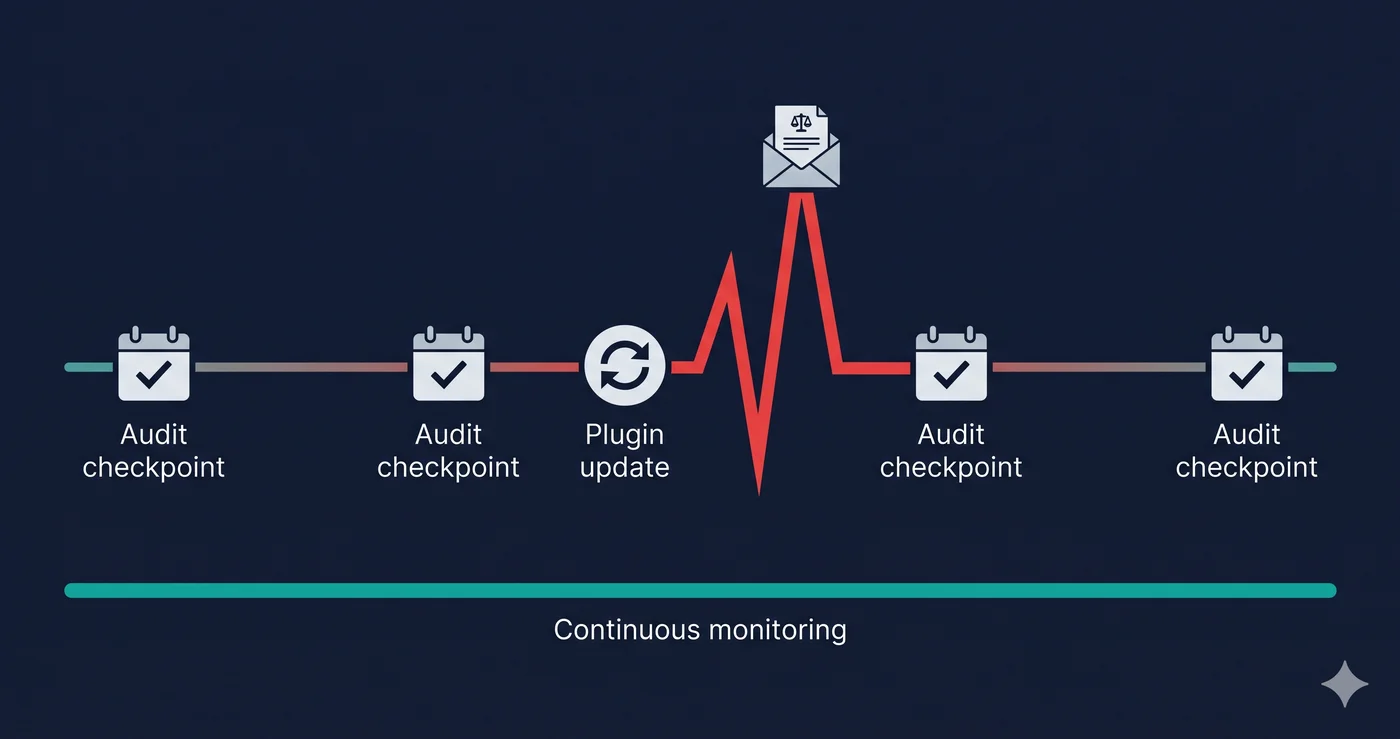
Serial plaintiff campaigns target eCommerce sites with the most detectable violations in the highest-traffic sectors. If your site has empty buttons, missing form labels, or unlabeled interactive elements, it matches the pattern every plaintiff firm scanner is looking for.
Find out what your site's accessibility profile looks like before someone else does. Run a free scan at adaguard.io — no sign-up required. ADAGuard's DOM-level scanner checks 50+ accessibility criteria against your fully-rendered page and returns a report that maps every violation to its WCAG criterion, severity level, and specific element location. That's the same structured output that appears in a demand letter — delivered to you first, so you can act on it rather than respond to it.