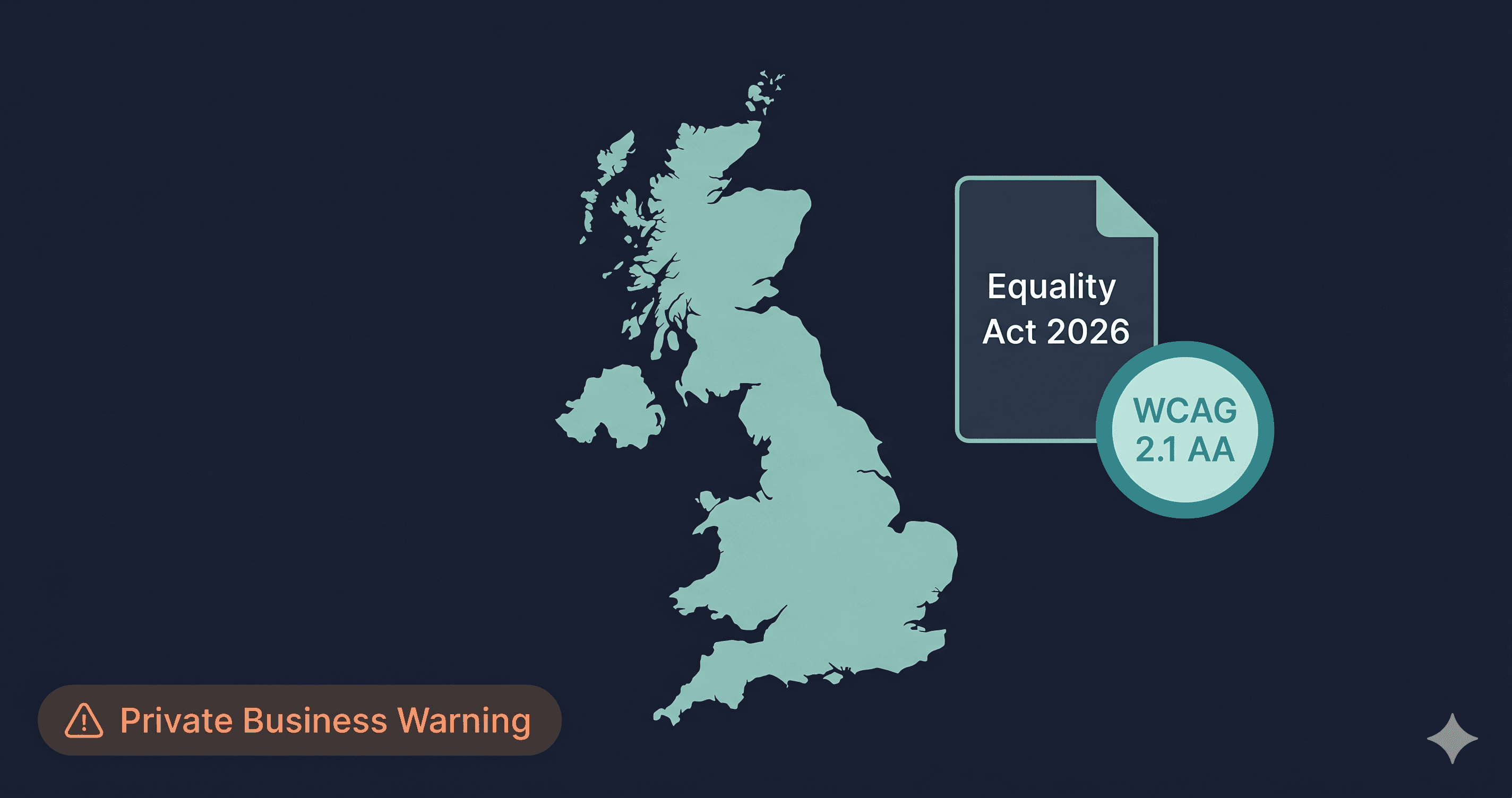
Equality Act claims over inaccessible websites are rising in the UK, and private businesses have no exemption. A blind user unable to navigate your checkout, a Deaf customer who cannot access your video content, or a user with motor disabilities trapped by your popup modal — each of these is a potential claim under Section 20 of the Equality Act 2010. Courts have already awarded compensation. The Equality and Human Rights Commission can investigate. And unlike the US, where ADA litigation is driven by serial plaintiffs and demand letters, UK claims tend to be brought by individual disabled users with direct personal experience of the barrier.
The UK doesn't have a single dedicated digital accessibility law for the private sector. What it has is the Equality Act 2010 — which creates a clear and enforceable obligation to make reasonable adjustments for disabled people accessing your goods, services, and information. For websites and apps, that means WCAG 2.2 AA is the standard courts and regulators look to when assessing whether a business took reasonable steps.
What the Equality Act Actually Requires
Section 20 of the Equality Act 2010 imposes a duty to make reasonable adjustments for disabled persons. For digital products and services, this duty applies when a provision, criterion, or practice — or a physical or virtual feature — puts a disabled person at a substantial disadvantage compared to a non-disabled person. In plain terms: if a blind user cannot complete a purchase because your site has no keyboard navigation or your images have no alt text, your site is putting that user at a substantial disadvantage. The Equality Act says you must take reasonable steps to fix it.
"Reasonable" is deliberately vague, but in practice, courts have applied WCAG 2.2 Level AA as the benchmark for what constitutes a reasonable adjustment in digital contexts. There is no single statutory reference that hard-codes WCAG into UK private-sector law — but in every accessibility dispute that has reached a UK court or the EHRC, WCAG has been the reference point.
Which WCAG Standard Applies in the UK?
The UK has two different frameworks depending on who you are:
Public sector: The Public Sector Bodies (Websites and Mobile Applications) Accessibility Regulations 2018 require compliance with WCAG 2.2 AA. Public sector bodies must publish accessibility statements and conduct regular audits. This is a hard legal mandate.
Private sector: There is no equivalent hard mandate. The Equality Act applies — and WCAG 2.2 AA is used as the benchmark — but the standard is assessed in the context of reasonableness, not as a prescriptive checklist.
In 2026, the UK government is consulting on extending accessibility requirements to private-sector digital services. Disability Rights UK surveys have shown overwhelming support for a new UK Accessibility Act that would bring private organisations under obligations closer to the public sector model. That legislation has not yet passed, but the direction of travel is clear: the current light-touch framework is expected to tighten.
| Organisation Type | Applicable Law | WCAG Standard | Hard Deadline? |
|---|
| UK public sector websites and apps | Public Sector Bodies Accessibility Regulations 2018 | WCAG 2.2 AA | Yes — ongoing |
| UK private businesses (goods and services) | Equality Act 2010 | WCAG 2.2 AA (benchmark) | No — but duty is immediate |
| UK businesses selling to EU customers | EAA via EN 301 549 | WCAG 2.1 AA (minimum) | Yes — June 2025 for new products |
| UK public sector apps (mobile) | Public Sector Bodies Accessibility Regulations | WCAG 2.2 AA | Yes — ongoing |
The Real Legal Risk: Compensation and EHRC Action
The consequences of non-compliance under the Equality Act are not abstract. A disabled person who cannot access your website can bring a claim in the County Court. Courts can award compensation, including damages for injury to feelings (distress caused by the discrimination). In 2023, a blind man received a £3,000 settlement after being unable to use a screen reader to access the Health and Social Care Northern Ireland website — a case that drew significant industry attention (source: disability rights organisations covering the case).
Beyond individual claims, the Equality and Human Rights Commission (EHRC) can investigate organisations and issue compliance notices requiring accessibility improvements. The EHRC has statutory investigation powers and can pursue enforcement through the courts without a private claimant initiating the process.
The UK's 14.6 million people with disabilities represent approximately 22% of the population (ONS 2023 estimates). A website that excludes a fifth of its potential market isn't just a legal risk — it's a revenue problem.
UK Businesses Selling to EU Customers: A Double Obligation
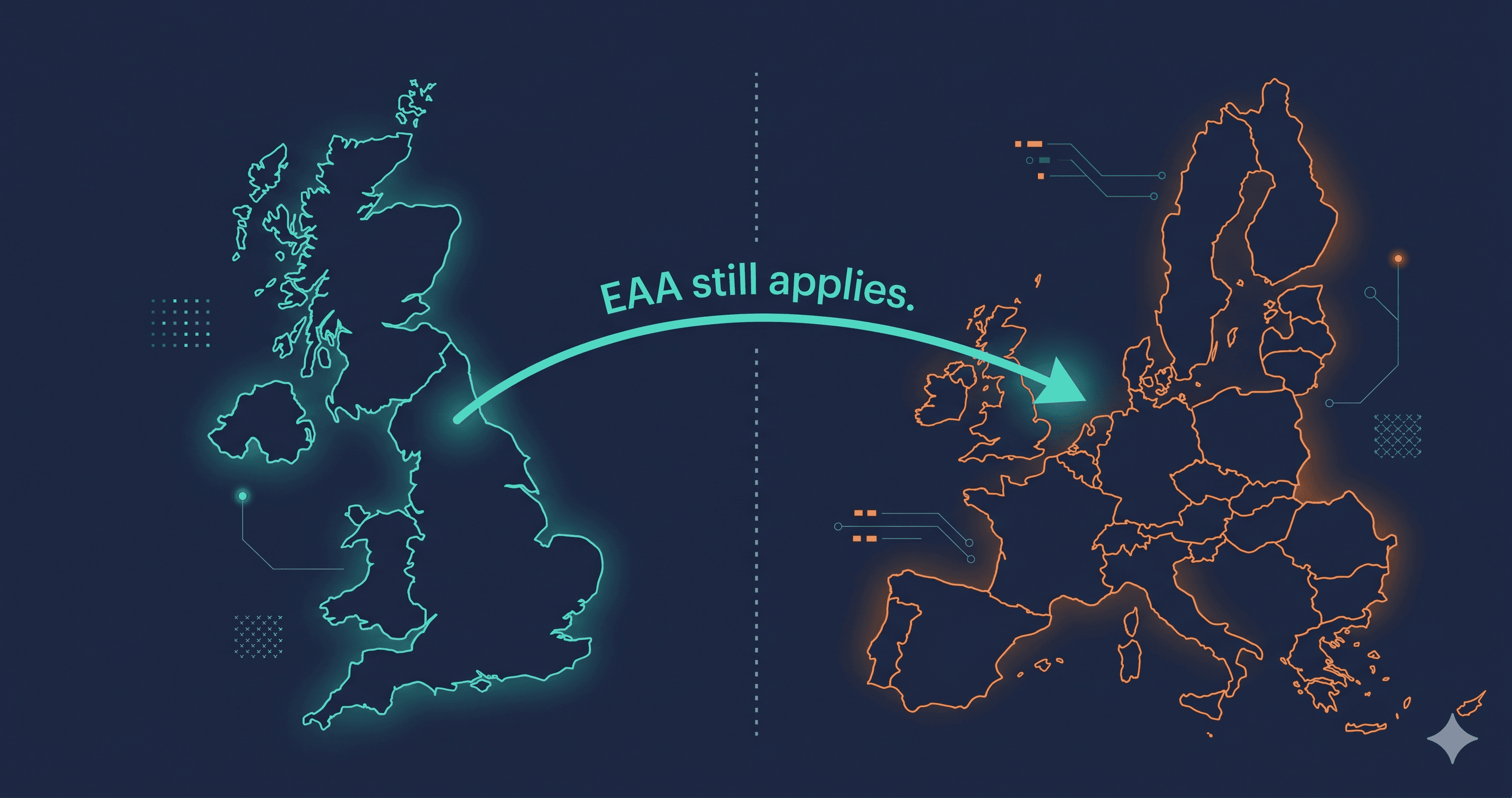
Post-Brexit, UK businesses are no longer subject to EU law domestically. But if you sell products or services to EU consumers, the European Accessibility Act (EAA) applies to your EU-facing digital touchpoints. The EAA doesn't care where your company is incorporated — it cares where your customers are.
This creates a dual obligation for UK businesses with EU sales:
- Domestically: Equality Act 2010 duty to make reasonable adjustments, WCAG 2.2 AA as the benchmark
- EU-facing: EAA compliance via EN 301 549, with June 2025 enforcement already live
Many UK agencies and e-commerce businesses are managing both frameworks simultaneously. The practical approach is to build to WCAG 2.2 AA — which satisfies both the UK Equality Act benchmark and the core web content requirements of EN 301 549. One standard, two compliance regimes.
What's Changing in 2026 for UK Businesses
In 2026, the UK's private-sector accessibility landscape is in transition. A few developments to track:
New UK Accessibility Act consultations: Disability Rights UK surveys show 89% of disability sector respondents support a new Act extending public-sector-style obligations to private businesses. If enacted, this would transform the current soft-law Equality Act framework into a hard mandate with specific WCAG version requirements.
Public sector WCAG 2.2 upgrade: Government departments and councils that were previously compliant with WCAG 2.1 are now required to have upgraded to WCAG 2.2 AA. WCAG 2.2 introduced nine new success criteria including focus appearance and minimum touch target size. If public-sector sites in your sector have had to upgrade, expect the same standard to become the private-sector benchmark in short order.
Procurement pressure: UK enterprise procurement teams, particularly in financial services and retail, are beginning to insert WCAG compliance clauses into supplier contracts. This is most advanced in sectors with strong disability representation frameworks.
The Scope of the Problem: Where Violations Accumulate
The 2026 WebAIM Million report analysed one million home pages and found that 83.9% have low-contrast text and an average of 56.1 detectable accessibility errors per page — an increase of 10.1% from the previous year. UK websites are not exempt from these trends. The WebAIM Million data is drawn from the top one million global sites by traffic; UK e-commerce and service websites are represented throughout.
The most common violations across UK commercial websites include unlabelled form fields, missing alt text on images, keyboard traps in modals and navigation menus, and insufficient colour contrast in text elements. These are not obscure edge cases — they're the violations that directly prevent disabled users from completing purchases, accessing account information, or navigating your services.
What to Do When You Find Violations
Run your site through ADAGuard to get a current picture of your WCAG 2.2 AA status. ADAGuard covers 22 custom checker categories plus axe-core integration, testing against WCAG 2.2 AA across 50+ checks — giving you ~78% automated coverage of WCAG 2.2 AA criteria (43 of 55).
Once you have a scan report, violations fall into two resolution tracks. Issues within your own codebase — missing labels, contrast failures, keyboard navigation gaps — go into your development sprint with the WCAG criterion number as the ticket reference. Issues introduced by third-party tools — a consent banner that creates a keyboard trap, a chat widget that isn't screen-reader compatible — require a vendor ticket with the specific WCAG failure cited.
For the Equality Act, the goal is to demonstrate that you took reasonable steps to make your site accessible. A documented scan report, a remediation plan with prioritised issues, and evidence of fixes being implemented all support a "reasonable adjustments" defence if a claim arises. The companies most exposed to Equality Act liability are those with no accessibility testing programme whatsoever — not those who have identified violations and are working through them.
The 30-Second Fix
You can't defend a reasonable adjustments claim with nothing. Paste your URL into adaguard.io — free, no signup required — and get an instant WCAG 2.2 AA scan. ADAGuard's report gives you a prioritised issues list with criterion numbers your developers can act on immediately. That scan is the beginning of a documented compliance programme. For UK businesses, it's also the beginning of your Equality Act defence.