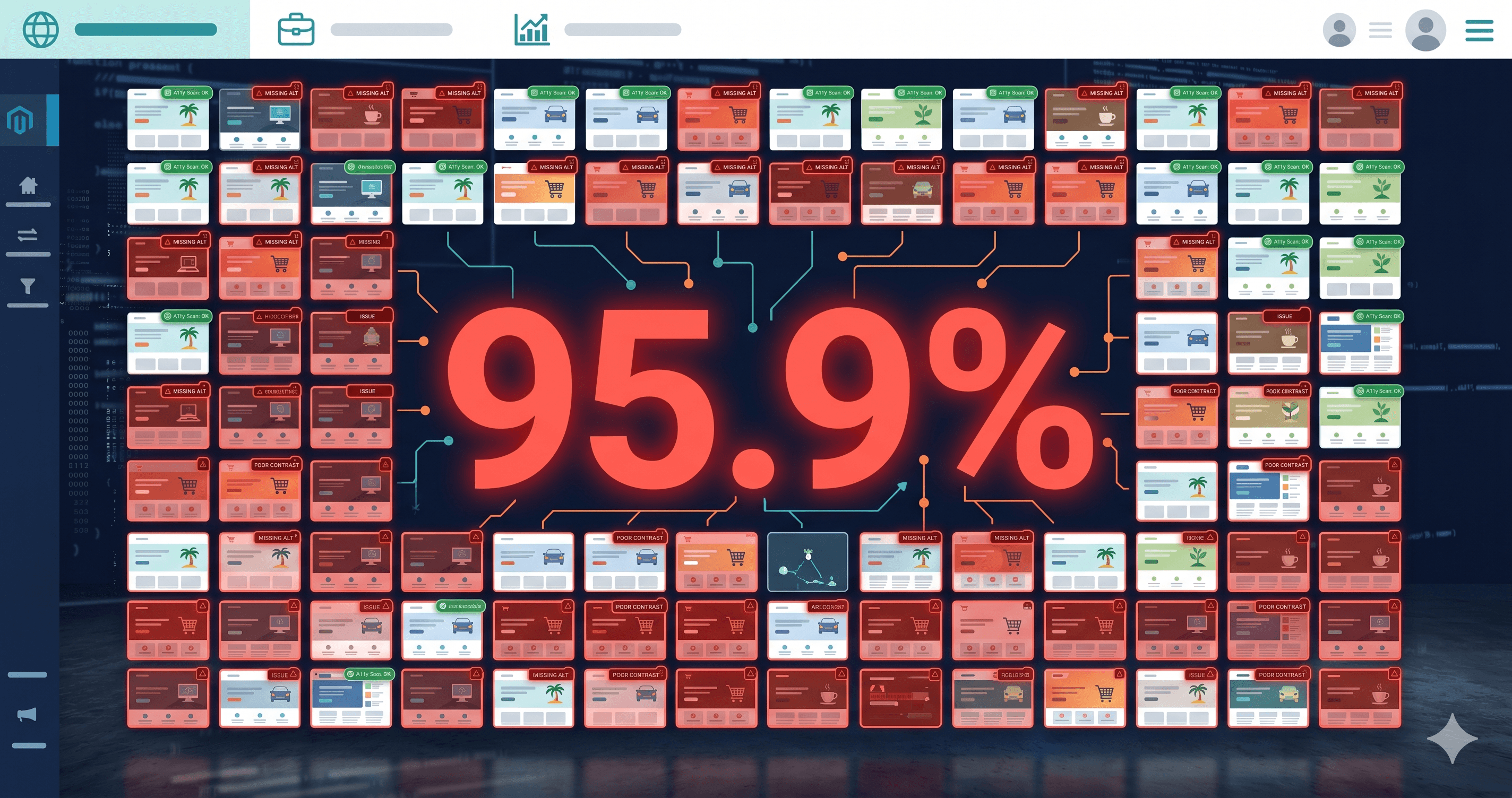
95.9% of the one million most-visited websites on the internet have detectable WCAG 2 failures — and for the first time in six years, that number just got worse. The WebAIM Million 2026 report, published in March 2026, reversed a cautious trend of gradual improvement. The web is becoming less accessible, not more, and eCommerce sits at the center of the failure.
WebAIM analyzes the home pages of the top 1,000,000 websites every year using its WAVE accessibility engine — rendering each page fully in a browser before scanning. The 2026 edition is the most alarming since 2019: 95.9% of home pages had detectable WCAG 2 conformance failures, up from 94.8% in 2025. The average page now carries 56.1 accessibility errors — a 10.1% increase in a single year. Users with disabilities would expect to encounter a barrier on 1 in every 26 page elements they interact with.
What Reversed Six Years of Progress
Six consecutive years of cautious improvement ended sharply in 2026, and WebAIM's conclusion is direct: home pages are becoming more complex, not more accessible. The average page now contains 1,437 elements — a 22.5% increase in a single year. ARIA attributes increased 27% in the same period. More third-party frameworks, more AI-generated code, more app widgets injected at load time — all correlating with more errors.
The "vibe coding" pattern is showing up in the data. Pages with more ARIA attributes had significantly more detectable errors: 59.1 per page on average compared to 42 for pages without ARIA. This doesn't mean ARIA itself causes errors — it means developers are reaching for complex accessibility markup without understanding the fundamentals it's meant to serve.
The Six Failures That Account for 96% of All Errors
WebAIM found the same six failure categories dominating the results for seven consecutive years. These categories account for 96% of all detected errors — and they map directly to the violations most commonly cited in ADA demand letters:
| WCAG Failure Type | % of Home Pages | Change vs. 2025 |
|---|
| Low contrast text | 83.9% | ↑ Up from 79.1% |
| Missing image alt text | 53.1% | ↓ Down from 55.5% |
| Missing form input labels | 51% | ↑ Up from 48.2% |
| Empty links | 46.3% | ↑ Up from 45.4% |
| Empty buttons | 30.6% | ↑ Up from 29.6% |
| Missing document language | 13.5% | ↓ Down from 15.8% |
Source: WebAIM Million 2026 Report.
Four of the six failure types are getting worse. Low contrast text — invisible to a developer looking at a modern monitor — appears on 83.9% of home pages with an average of 34 distinct instances per page. That's not an isolated oversight. That's a site-wide pattern generated by brand colors that were never tested against WCAG thresholds.
The other categories are equally fundamental. Missing form labels. Empty buttons. Images without alt text. These aren't obscure WCAG edge cases that require expert interpretation. They're the same failures that show up in ADA demand letters — and the same failures that an automated wcag checker surfaces in under two minutes.
eCommerce Gets the Worst of It
Not all websites fail equally. WebAIM's category analysis reveals that Shopping sites averaged 71 errors per page — 26.6% above the already-alarming web-wide baseline. Shopify-powered stores specifically averaged 75.1 errors per page, placing them 33.9% above average. Shopify stores outperformed only PrestaShop (143.2 errors/page) among the major eCommerce platforms analyzed.
For context: Shopify stores failed worse than travel sites, entertainment sites, and news sites. The average Shopify home page is among the least accessible in the entire WebAIM dataset.
For eCommerce operators, that correlation is not abstract. It maps to the approximately 70% share of ADA web accessibility lawsuits that target online retailers, according to UsableNet data. The websites with the most errors are in the industry that attracts the most lawsuits. That alignment is not a coincidence — it's a consequence.
Technology Choices Have Measurable Accessibility Impact
The 2026 WebAIM data also reveals something that should shape technology decisions. Your platform and framework choices have a direct, measurable effect on your baseline error count:
- PrestaShop: 143.2 errors/page (155% above average)
- Shopify: 75.1 errors/page (33.9% above average)
- Magento: 75.8 errors/page (35% above average)
- WordPress: 52.8 errors/page (5.8% below average)
- Next.js sites: 40.9 errors/page (27.1% below average)
This doesn't mean switching platforms solves accessibility compliance. But it does mean that apps and plugins compounding on top of an already-high baseline create a different risk profile than the same apps on a lower-error foundation. For Shopify merchants specifically: your platform's baseline errors plus your theme's errors plus your installed apps' errors produce a combined violation profile that's already running 34% above an already-broken web average.
Why Static Scanners Miss Most of What Matters
One of the persistent misconceptions in accessibility compliance is that running a free browser extension or a Lighthouse audit is equivalent to a real accessibility check. The WebAIM methodology — rendering the full DOM before scanning — exists precisely because static HTML analysis misses the violations that appear after JavaScript executes.
For eCommerce sites especially, the most consequential violations are dynamic: cart drawers that fail focus management, modal overlays that trap keyboard users, third-party review widgets that inject unlabeled elements into the page after load. These violations don't exist in your HTML source. They exist in the rendered DOM that a browser builds when a real user visits your page.
Tools that rely solely on a single rule engine cover only a subset of WCAG 2.1 AA criteria. ADAGuard's scanner runs 22 custom check categories against the fully-rendered DOM — covering approximately 78% of WCAG 2.2 AA (43 of 55 criteria) — including custom modules for color contrast calculation, ARIA validity, focus indicator detection, and link text quality, plus full axe-core integration.
The gap between 40% coverage and 78% coverage is the gap between a false sense of security and an actual compliance picture.
What to Do When Your Website Accessibility Checker Returns Results
When a website accessibility checker scan surfaces violations, the remediation path depends on where each violation lives. Violations fall into two categories:
What your team controls directly: Image alt text in your product catalog, page title accuracy, document language declarations, visible text contrast values. These can be addressed by your content or development team without waiting for vendor involvement.
What requires a ticket to a platform or app vendor: Cart drawer focus management failures, third-party modal keyboard traps, ARIA implementation issues in review widgets or chat apps. These need WCAG criterion numbers from your scan report — the specific criterion reference like WCAG 4.1.2 or WCAG 1.3.1 — included in the support ticket so the vendor understands the exact technical requirement.
The scan report tells you which bucket each violation belongs to. It also tells you which specific violations exist on your site — not which violations are theoretically possible on your platform.
The 30-Second Fix
The WebAIM data establishes a 95.9% probability that your site has detectable WCAG failures. The question isn't whether they exist — it's which ones, how many, and which pages they're on.
Paste your URL at adaguard.io for an instant free scan. No sign-up required. ADAGuard maps every detected violation to its WCAG criterion, severity level, and the specific DOM element — the same structured output you'd want to have before a plaintiff attorney generates their own version. That report is your starting point for legitimate, documented remediation in 2026.