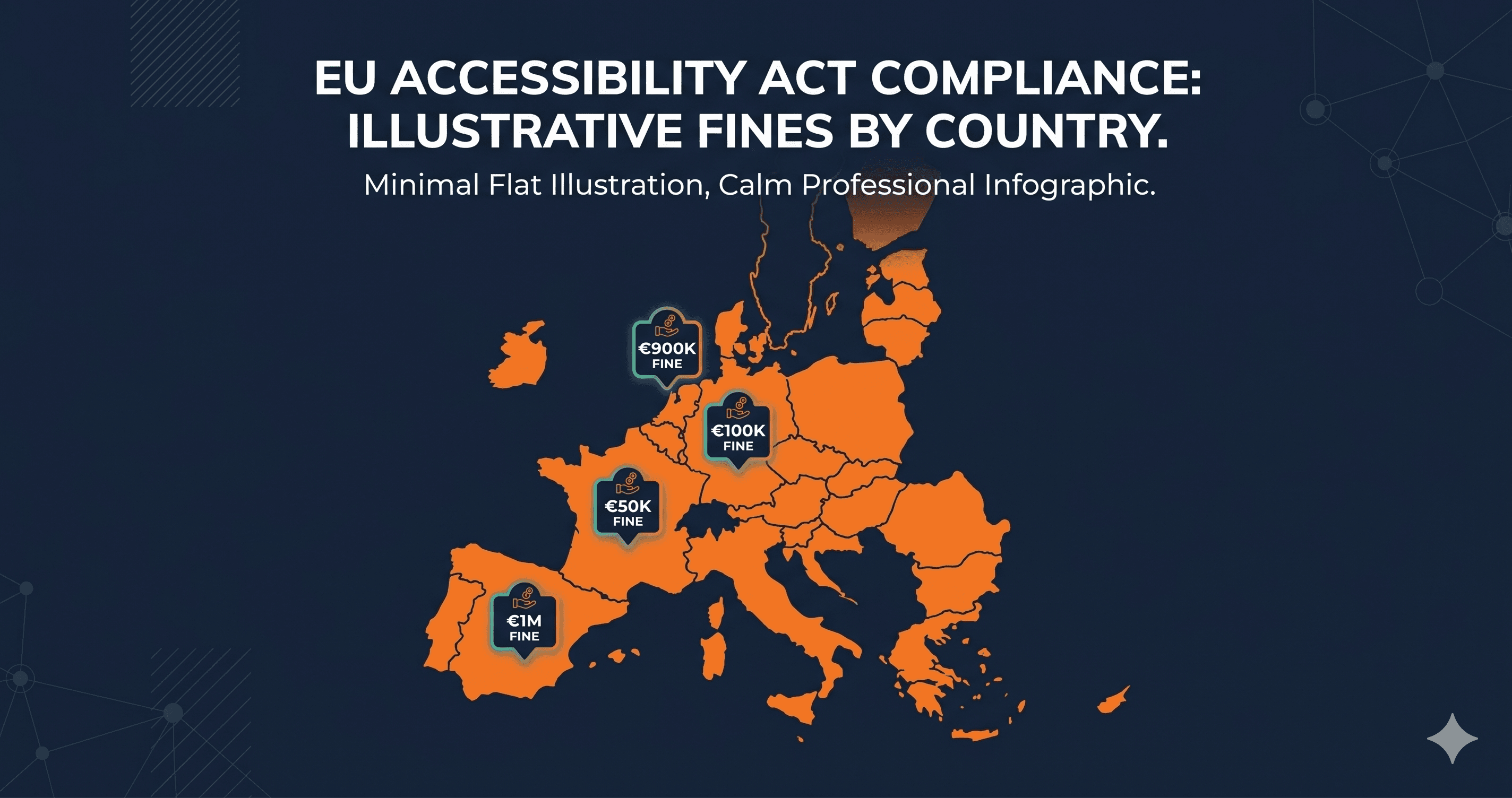
A letter from the Netherlands ACM is not the same as an ADA demand letter from a plaintiff's attorney. It doesn't negotiate. It doesn't settle for a few thousand dollars and a promise to fix things. It sets a fine — and the maximum in the Netherlands is €900,000, or up to 10% of annual turnover.
The European Accessibility Act came into full enforcement on June 28, 2025. Every EU member state has transposed the directive into national law, and every state has its own enforcement agency, its own fine structure, and its own enforcement approach. The ranges are not minor. From Germany's €100,000 per-violation penalty to Spain's €1,000,000 maximum for very serious infractions, the EAA creates a fine exposure that most US and non-EU merchants have not modeled.
For the underlying technical requirements that trigger these fines, see our EAA compliance overview.
Why Fines Vary So Much Across EU Countries
The EAA is a directive, not a regulation. That means it sets a compliance target — the technical requirements of EN 301 549 / WCAG 2.1 AA — but leaves the specific penalty structure to each member state. The result is a patchwork of national laws, each with its own maximum fine, its own enforcement agency, and its own process for lodging and investigating complaints.
This matters for merchants who sell across multiple EU markets. A Shopify store with customers in Germany, France, the Netherlands, and Spain could theoretically face enforcement from four different authorities under four different fine structures for the same underlying violation.
The Full EAA Fine Schedule by Country
| Country | Max Fine | Enforcement Agency | Enforcement Notes |
|---|
| Netherlands | €900,000 or 10% of annual turnover | ACM (Authority for Consumers and Markets) | Highest EAA penalty in EU. Mandatory compliance reporting since Oct 2025. Can issue fines immediately for serious violations. First formal audits launched Q4 2025. |
| Spain | €1,000,000 (very serious violations) | Ministry of Social Rights + autonomous communities | Three-tier structure: minor €30K–€90K, serious €90K–€300K, very serious €300K–€1M. Multiple regional authorities can act simultaneously. |
| Sweden | €1,000,000+ for serious violations | PTS (Post and Telecom Authority) | High fines and strong enforcement culture. Formal enforcement program launched Q4 2025. |
| France | €250,000 for repeat violations | ARCOM, ARCEP, DGCCRF | Base: €7,500 per violation for legal entities. Already active: formal notices to Carrefour, Auchan, Leclerc, and Picard (late 2025). Emergency injunctions filed Nov 2025. |
| Germany | €100,000 per violation | BAuA + Bundesnetzagentur | Transposed via BFSG (effective June 28, 2025). Private Abmahnungen allowed — competitors and associations can sue. First Abmahnungen filed Aug 2025. |
| Italy | Up to 5% of annual revenue | AgID | Highest relative exposure for large companies. Most generous cure period: 90 days. |
| Belgium | €50,000–€200,000 | Various sector regulators | Enforcement programs being established. |
| Ireland | Proportionate fines | CCPC + sectoral regulators | Complaint-based initially, with growing proactive auditing. |
| Poland | In development | UKE | Transposition still in progress as of 2026. |
The Three Countries With the Most Active Enforcement
Germany deserves special attention because of its private enforcement mechanism. Under BFSG (Germany's EAA transposition), competitors and associations can issue Abmahnungen — formal warning letters with legal fee recovery — against non-compliant businesses. This is not government enforcement; it's market participants using accessibility law as a competitive tool. The first wave of Abmahnungen targeting online retailers began in August 2025 (Greenberg Traurig, 2025). A US merchant selling into Germany could receive an Abmahnung from a German competitor — and be required to pay the competitor's legal fees.
France is the most documented enforcement jurisdiction so far. Within days of the June 2025 EAA enforcement deadline, French disability advocacy organizations issued formal legal notices to four of the country's largest retailers: Carrefour, Auchan, E.Leclerc, and Picard. When those retailers' compliance efforts proved insufficient, emergency injunctions were filed in November 2025 (UsableNet, 2025 enforcement timeline). As of May 2026, those cases remain pending — but they establish the template for how advocacy-driven enforcement will work across the EU.
The Netherlands stands out for its compliance reporting requirement. Since October 2025, companies offering covered services to Dutch consumers must proactively report their accessibility compliance status to the ACM. This is not a passive "wait to be audited" model — it creates an active compliance registry, and companies that fail to report or report inaccurately face enforcement action independent of any specific accessibility violation. The ACM's first formal audits ran in Q4 2025.
What Triggers Enforcement
Based on the first year of EAA enforcement across EU member states, the triggers fall into three categories:
Consumer complaints. A disabled user who cannot complete a purchase, navigate a site, or access a service has standing to file a complaint with national enforcement authorities. Complaint portals are active in most member states.
Advocacy organization referrals. Disability organizations like those that targeted French retailers have legal standing to file on behalf of users in most EU jurisdictions. Their organizational capacity to identify and pursue violations at scale mirrors what US plaintiff law firms do in the ADA space.
Proactive market surveillance. The Netherlands ACM, Sweden's PTS, and Germany's BAuA have all launched formal audit programs targeting e-commerce and digital services. These are systematic, not random — they focus on high-traffic sectors and high-impact violations.
The common thread across all three trigger types is this: if your site has violations that prevent disabled users from completing fundamental tasks (finding products, reading content, filling forms, completing checkout), you are a candidate for enforcement action regardless of which trigger type reaches you first.
Fine Exposure for a Multi-Market E-Commerce Store
Consider a US-based DTC brand with meaningful sales in Germany, France, the Netherlands, and Spain — a common profile for a mid-sized Shopify Plus merchant. If that store has critical WCAG violations (missing alt text at scale, unlabeled checkout form fields, keyboard traps in popups), the theoretical fine exposure under all four national frameworks simultaneously is:
Germany: up to €100,000 per violation × number of violations
France: €7,500 per violation, up to €250,000 for repeat violations
Netherlands: up to €900,000 or 10% of annual turnover
Spain: up to €1,000,000 for very serious violations
No company has been fined the theoretical maximum in any single jurisdiction yet. But the enforcement machinery is operating, the first formal actions are under way, and the trajectory is toward increasing enforcement intensity through 2026 and 2027. According to UsableNet's 2025 report, 4,800+ ADA lawsuits were filed in the US in 2025 — a significant year-over-year increase — and EAA enforcement follows the same pattern: slow start, rapid escalation once the first formal penalties are issued and publicized.
What to Do When You Find Violations
Your scan report is the foundation of your compliance defense. When ADAGuard identifies violations, the report maps each issue to the specific WCAG criterion — 1.1.1 for missing alt text, 2.1.2 for keyboard traps, 1.4.3 for color contrast failures. Those criterion numbers are the language enforcement authorities use.
Use the scan report in two ways: hand the WCAG criterion numbers to your developer for direct-fix items in your own code, and include them in support tickets to vendors responsible for third-party components. Documenting that you identified violations and initiated remediation is a meaningful factor in enforcement proceedings — it demonstrates good faith compliance effort, which affects both the likelihood of a fine and the amount.
ADAGuard covers 23 accessibility check modules — 22 custom checkers plus axe-core — achieving approximately 78% WCAG 2.2 AA automated coverage. It renders JavaScript, checks the live DOM, and includes authenticated scanning for checkout flows and logged-in pages.
The 30-Second Fix
Before you model your EAA fine exposure across EU markets, you need to know what violations actually exist on your live site. Enforcement authorities audit live pages — the same ones your EU customers see, with all JavaScript rendered, all third-party apps loaded.
Scan your store at adaguard.io — free, no signup required. The report gives you a violation list mapped to WCAG criteria and severity: the starting point for both developer remediation and EAA compliance documentation.
The fines are real. The enforcement is active. Knowing your exposure is the first step.