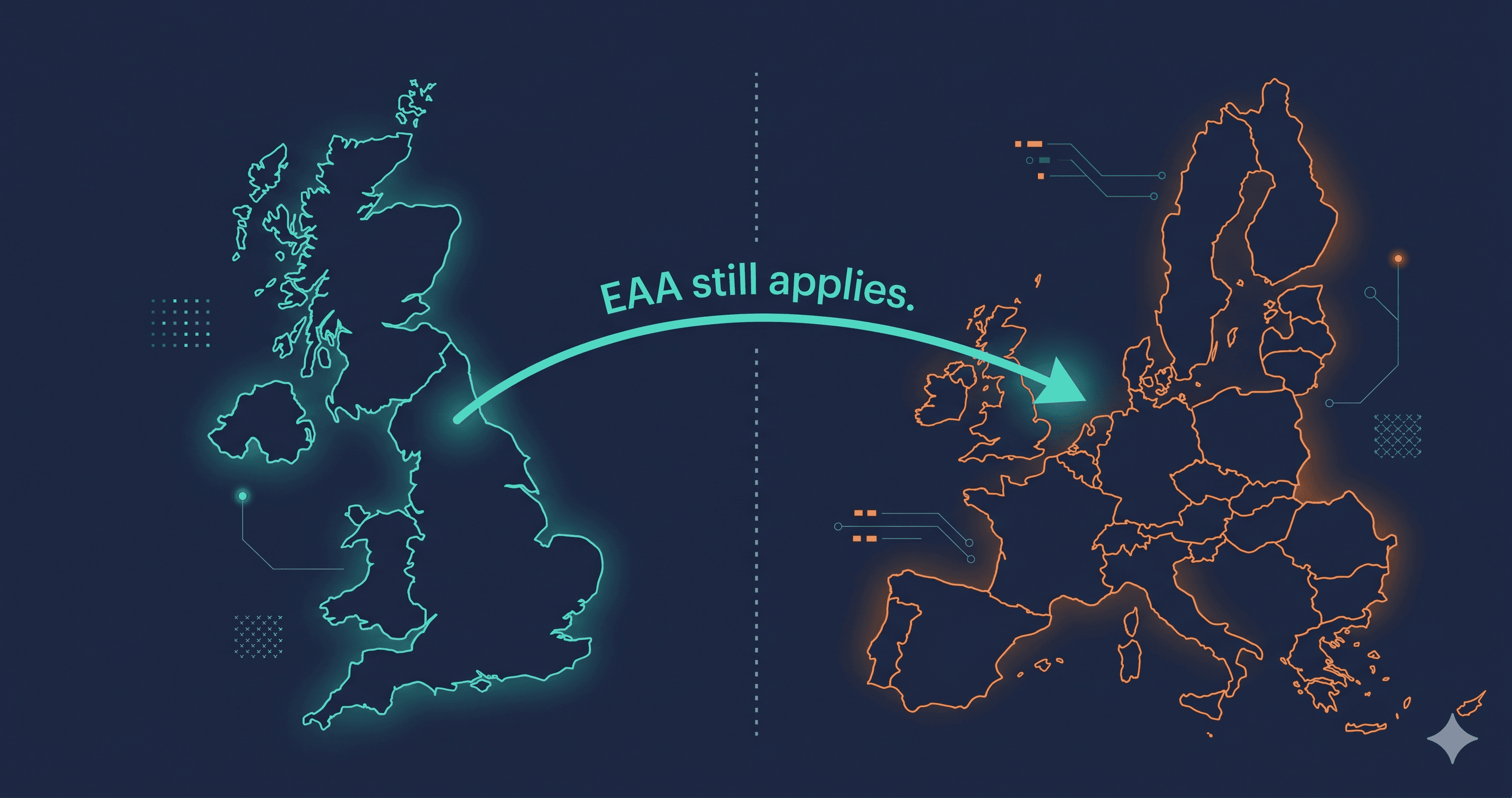
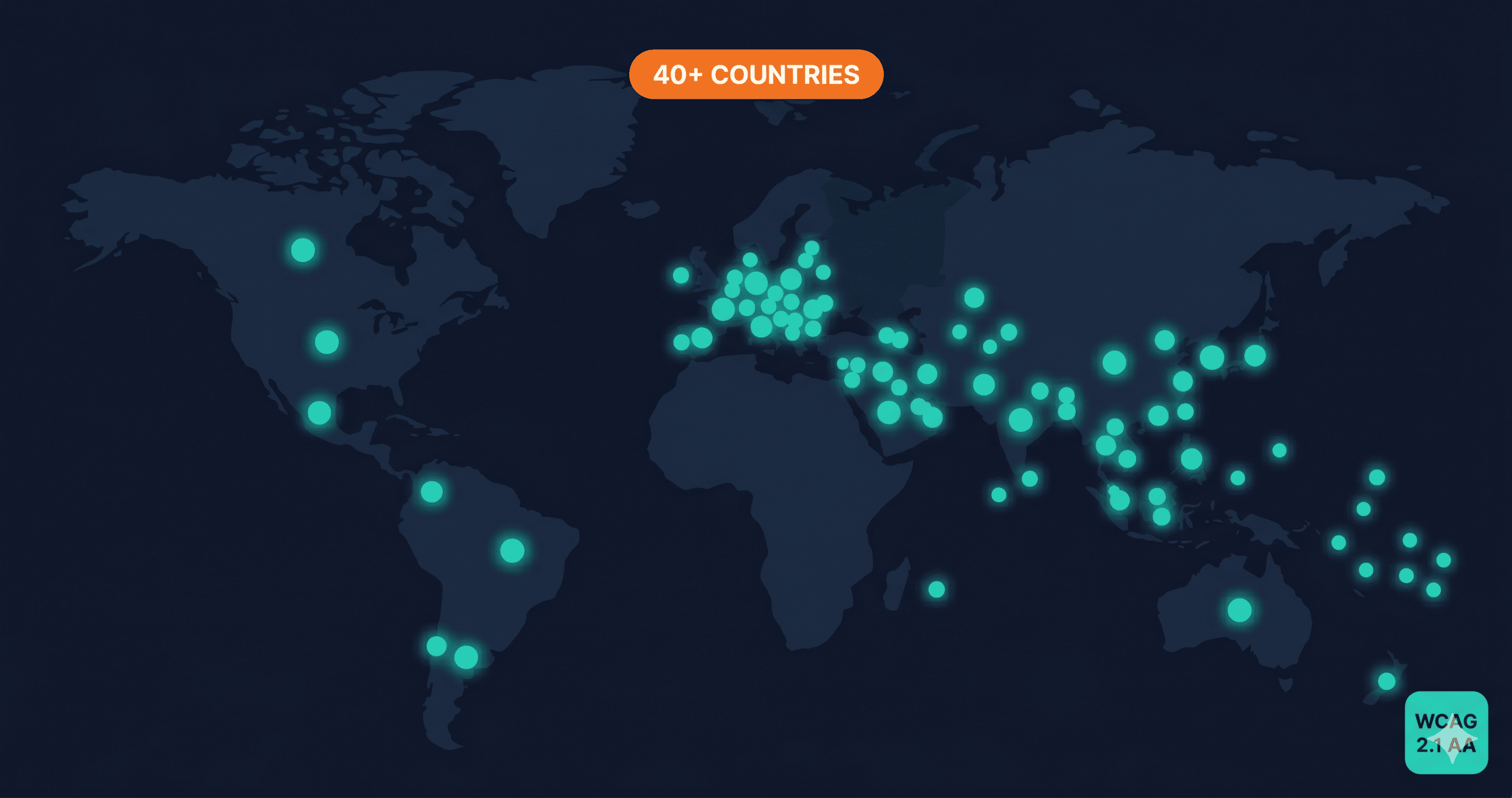
Leaving the EU did not exempt UK businesses from the European Accessibility Act. If your website, app, or digital service reaches customers in France, Germany, Spain, or any other EU member state, you are subject to EAA compliance requirements — full stop. Brexit changed your relationship to EU membership; it did not change the reach of EU consumer protection law.
This is the most common misunderstanding UK digital businesses carry into 2026, and it is expensive to learn it late. The EAA came into full enforcement on June 28, 2025, and enforcement activity — formal notices, competitor warning letters, and emergency injunctions — is already underway.
See our EAA compliance overview for the full requirements, regardless of where your business is based.
How EAA Applies to UK Companies Selling Into the EU
The EAA (EU Directive 2019/882) applies based on where customers are, not where a business is incorporated. The relevant legal test is whether a company places products or services on the EU market or makes them available to EU consumers. Being headquartered in London, Manchester, or Edinburgh does not create an exemption.
The practical scope is broad:
- A UK e-commerce store shipping physical goods to Germany must ensure its product pages, checkout flow, and account portal meet EN 301 549 (WCAG 2.1 AA) standards for German customers.
- A UK SaaS company with subscribers in France is providing a digital service to EU consumers — EAA applies to the platform experience those French users encounter.
- A UK media company with paying subscribers in Italy must ensure its streaming interface meets EAA requirements for Italian users.
- A UK fintech offering any service to EU residents is subject to EAA for those users.
The one genuine exemption: micro-enterprises with fewer than 10 employees and annual turnover below €2 million. If you fall below both thresholds, EAA compliance is not legally mandated — though accessible design still serves roughly 135 million disabled people in the EU.
What UK Domestic Law Requires
Understanding the EAA's reach on UK businesses requires separating two distinct legal obligations:
1. UK Equality Act 2010 — requires businesses to make "reasonable adjustments" for disabled users. There is no WCAG mandate written into the Act itself, but courts and tribunals use WCAG 2.1 AA as the benchmark for what a "reasonable adjustment" looks like. Equality Act discrimination claims related to inaccessible websites have resulted in settlements, and case law is building.
2. EAA via EU market access — applies to any UK business whose digital products or services reach EU consumers, regardless of Brexit. This is not optional compliance if you want to serve EU markets.
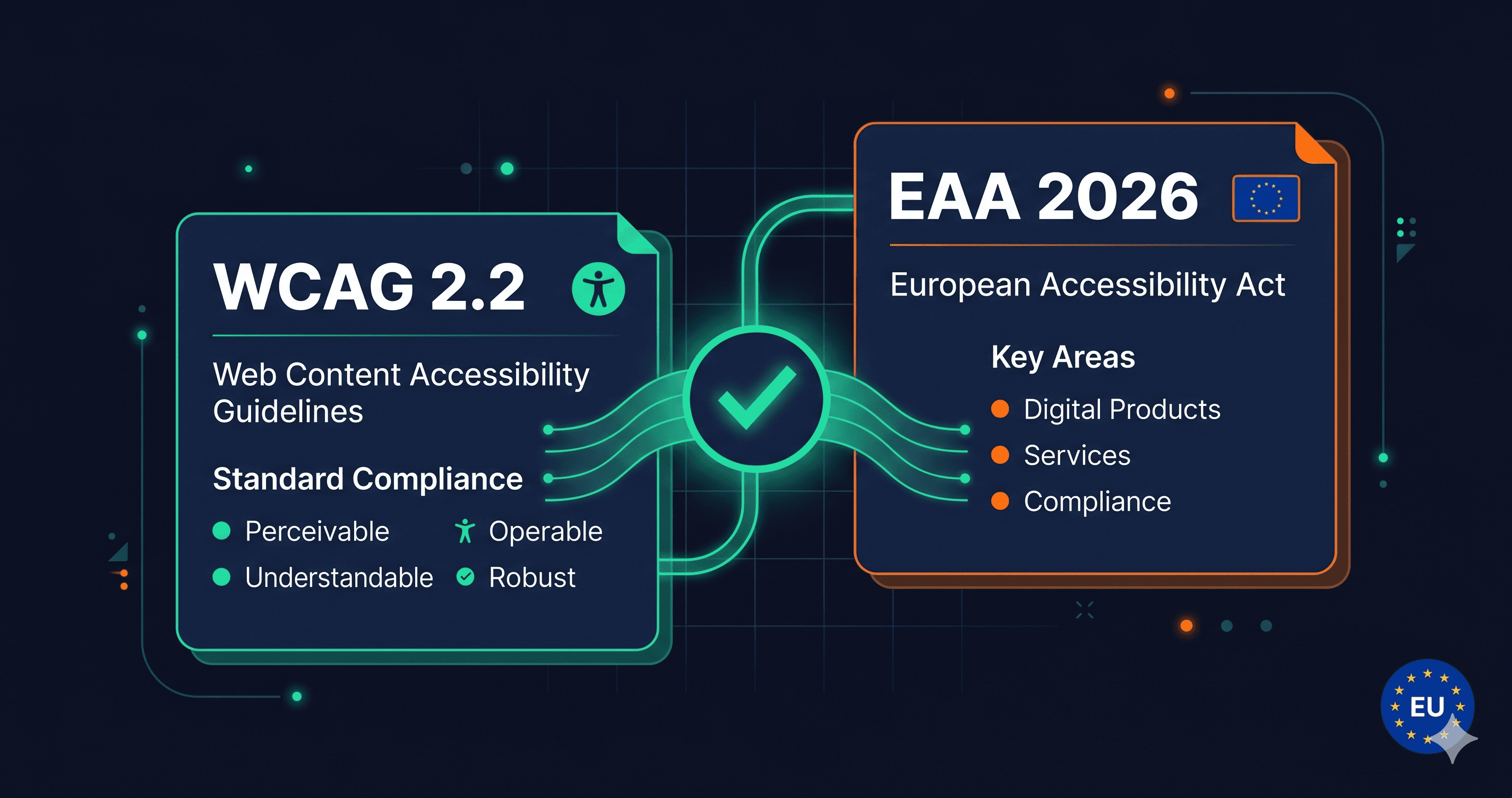
These are separate obligations, but they converge on the same technical standard: WCAG 2.1 AA. Meeting one substantially addresses the other.
The UK's Own Accessibility Framework Is Evolving
Post-Brexit, the UK is developing its own digital accessibility framework distinct from the EU's. As of 2026, the UK public sector remains subject to the Public Sector Bodies Accessibility Regulations 2018, which requires WCAG 2.2 AA for government websites and apps — a stricter standard than the current EAA baseline.
The UK government has been consulting on extending accessibility obligations from the public sector to private companies. These proposals remain in consultation as of mid-2026, but the direction of travel is clear: private sector mandates are coming, and WCAG 2.2 will be the bar.
This gives UK businesses operating today an unusual position: legally obligated under EAA to meet WCAG 2.1 AA for EU-facing services, and likely to face WCAG 2.2 requirements domestically in the next legislative cycle.
A Tale of Two Enforcement Models
The most practically important difference between EAA and UK Equality Act enforcement is who comes after you and how.
| Factor | UK Equality Act 2010 | EAA (EU enforcement) |
|---|
| Who enforces | Individual claimants through Employment Tribunals / courts | National regulatory agencies (ARCOM, ACM, Bundesnetzagentur, etc.) |
| Who triggers action | Disabled person experiences discrimination | Regulator audit, disability org complaint, competitor warning |
| Standard | WCAG 2.1 AA (benchmark by courts) | EN 301 549 = WCAG 2.1 AA (binding technical standard) |
| Typical UK outcome | Compensation, compliance agreement | Formal notices, fines, market removal |
| Max penalty | Unlimited compensation (discrimination awards) | Up to €1M (Spain/Sweden), €900K (Netherlands) |
| Scope | UK customers | EU customers specifically |
| Timeline | Complaint-triggered, variable | Enforcement began June 2025, intensifying |
| Risk level now | Moderate and growing | Active enforcement underway |
For UK businesses, the EU enforcement model is more immediately concerning than UK domestic law — not because fines are inevitable, but because the regulatory infrastructure is already operating. France issued formal legal notices to four major retailers in July 2025. Germany saw private Abmahnungen — competitor warning letters — begin in August 2025. The Netherlands began mandatory reporting requirements in October 2025.
This is not theoretical future risk. It is active present risk for any UK business serving EU customers.
What "EU Customers" Looks Like in Practice
UK businesses often underestimate their EU customer footprint. Consider:
- Your analytics dashboard shows 8% of traffic from Germany. That's EU customers.
- You ship to EU countries via your standard checkout. Those transactions are covered.
- Your SaaS tool is available in multiple languages, including French or Spanish. EU customers can find and use it.
- Your email marketing platform has subscribers with .de, .fr, or .es email addresses.
If any of these describe you, EAA applies to the digital experience those users encounter. The specific elements in scope include: your website, your mobile app, your checkout flow, your customer account portal, your support portal, and any self-service transaction flow.
The WCAG 2.1 AA Standard: What UK Sites Typically Fail
According to WebAIM's 2025 accessibility analysis of the top one million websites, 96.3% of home pages had detectable WCAG 2.1 AA failures. The most common failures — low colour contrast, missing image alt text, unlabelled form inputs, and keyboard-inaccessible interactive elements — are the same violations appearing in EAA notices and ADA demand letters globally.
For UK businesses, the most common gaps appear in:
- JavaScript-rendered checkout elements (cart drawers, address forms, payment widgets)
- Third-party chat widgets and popups without keyboard dismiss
- Product filter interfaces without accessible focus management
- Cookie consent banners that trap keyboard users
These failures are invisible to static scanners. They only appear when a tool renders your live DOM and evaluates the interactive experience the way a screen reader user encounters it.
ADAGuard runs a live-DOM scan against 22 custom accessibility checker modules plus axe-core — approximately 78% WCAG 2.2 AA coverage (43 of 55 criteria). The reports map each failure to the specific WCAG 2.1 AA success criterion regulators and courts reference.
For UK businesses with EU market exposure, ADAGuard's authenticated scanning is particularly valuable: it can scan your logged-in checkout and account portal experiences, not just the public-facing homepage — which is where EAA-relevant failures most often live.
What to Do When You Find Violations
EAA violations fall into two practical buckets:
Platform-level fixes: These involve settings your developers or platform support team can address — adding alt text to product images, adjusting contrast ratios in your theme's CSS, enabling keyboard navigation on standard UI components. Your WCAG criterion numbers from the scan report are exactly what you hand to your development team or vendor's support with a remediation request.
Third-party app issues: Popups, chat widgets, review carousels, and payment overlays are often built by third parties. When your scan identifies violations in these elements, file a support ticket with the vendor citing the specific WCAG criterion (e.g., "2.1.2 No Keyboard Trap — your modal does not allow keyboard dismiss"). Vendors in the EU market are increasingly responding to these requests because they face EAA exposure too.
Scan first. The report tells you which violations exist in your specific EU-facing experience. Without that data, remediation is guesswork.
The 30-Second Fix
Go to adaguard.io and paste your URL for a free scan. No signup required. The report maps every detected failure to its WCAG success criterion — the exact reference format used in EAA notices, Equality Act proceedings, and ADA demand letters.
Brexit did not protect UK businesses from EAA. Your EU customers are still there, and so are the regulators watching their digital experience. Find out what violations you're carrying before a French disability rights organisation or a German competitor does it for you.