Your privacy lawyer knows GDPR. Your payroll software knows state tax laws. But does anyone on your team know that the European Accessibility Act came into full enforcement on June 28, 2025 — and that it applies to your US-based store if you have EU customers?
The EAA is not a future concern. If your Shopify or WooCommerce store shipped orders to customers in Germany, France, or the Netherlands this year, you were already subject to EAA enforcement before this article was written. The fine exposure in the Netherlands alone reaches €900,000. In Spain, very serious violations carry a €1,000,000 maximum. And unlike the ADA, you don't have to wait for a plaintiff to find you — enforcement authorities audit proactively.
See our EAA compliance guide for the full technical standard both frameworks are measured against.
The Core Difference: Who Comes After You
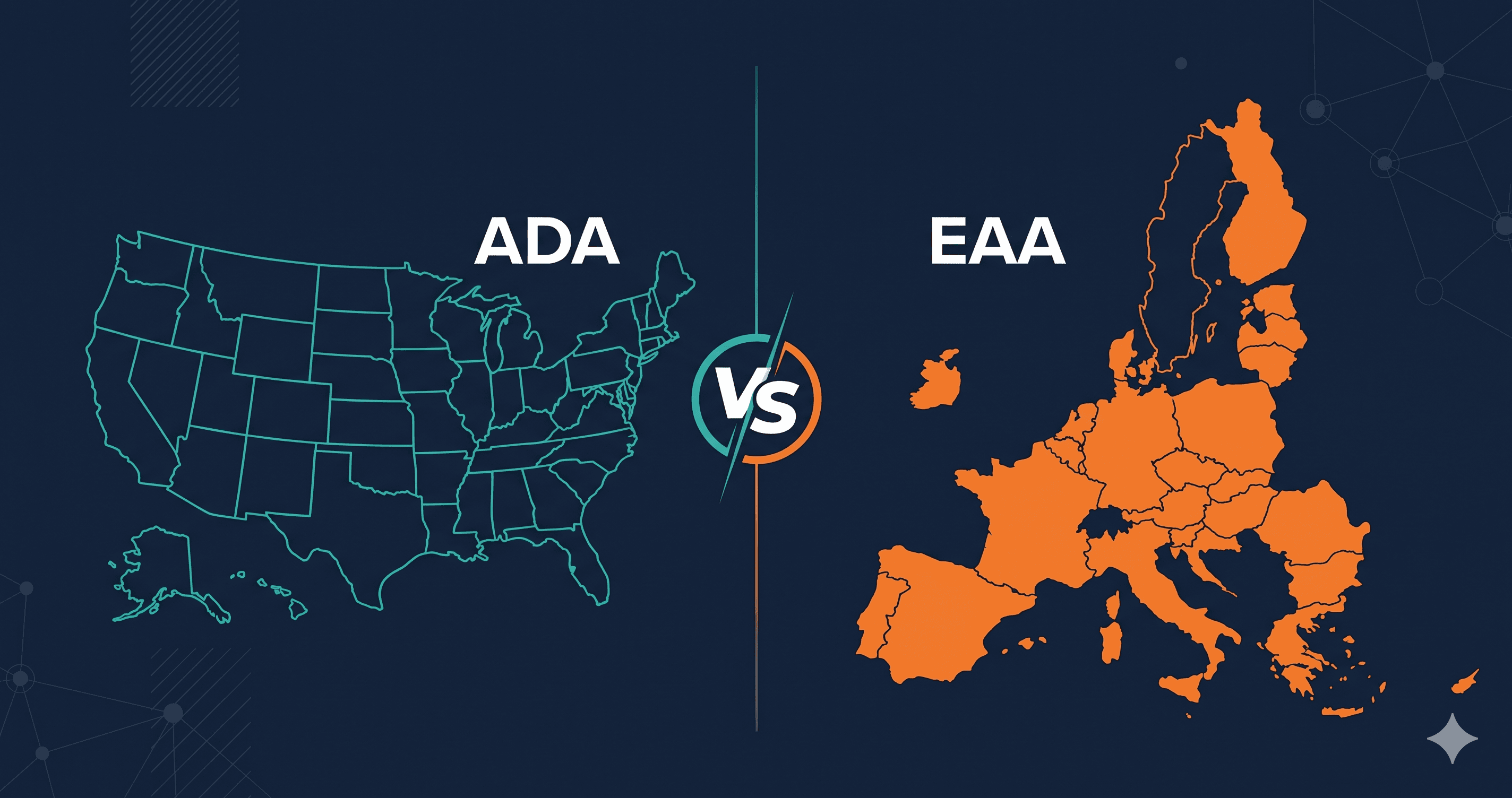
The ADA and EAA both require WCAG 2.1 Level AA compliance for web content. That's where the similarity ends. The enforcement mechanism is fundamentally different — and the EAA model is, in some ways, harder to manage than the ADA lawsuit model.
| Factor | ADA (USA) | EAA (EU) |
|---|
| Who enforces | Private plaintiffs + DOJ | National government agencies (27 countries) |
| Enforcement trigger | A plaintiff files a lawsuit | Agency audit, consumer complaint, or competitor complaint |
| Who pays legal fees | You do, even to defend | Regulatory process — penalties go to the state |
| Typical exposure | $25K–$100K settlement + attorney fees | €5K–€1M fine depending on country and violation severity |
| Standard required | WCAG 2.1 AA (case law standard, no DOJ rule for private business) | EN 301 549 = WCAG 2.1 AA (mandatory) |
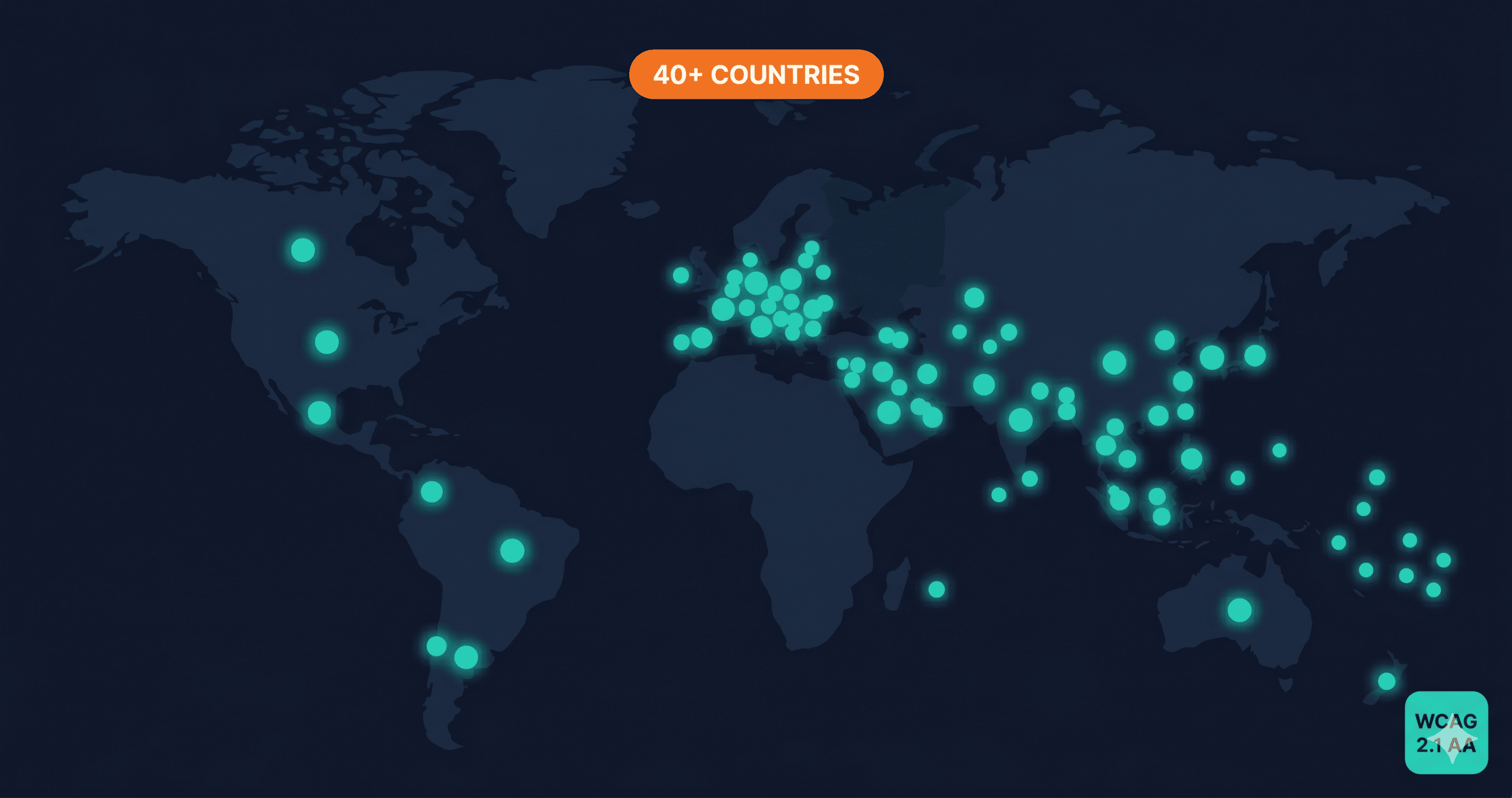
| Does it apply to you? | US businesses + anyone serving US users | Anyone selling to EU users, including US companies |
| Warning period | Often none — lawsuit filed first | Varies: Germany allows Abmahnungen (warning letters); France issued notices first |
| Market restriction | No | Yes — authorities can ban products from EU market |
The ADA is plaintiff-driven. Someone with disabilities, often represented by a law firm that scans for violations programmatically, files a complaint or demand letter. You respond, negotiate, remediate.
The EAA is authority-driven. The Netherlands' ACM began mandatory compliance reporting in October 2025. Germany's BFSG permits competitors to file Abmahnungen — private warning letters with legal fee recovery — which started appearing in August 2025 (Greenberg Traurig, 2025). France's advocacy organizations filed emergency injunctions against Carrefour, Auchan, and Leclerc in November 2025 (UsableNet, 2025). These are not plaintiffs. These are regulators and advocacy bodies operating under national enforcement frameworks.
Why "I'm Based in the US" Is Not a Defense
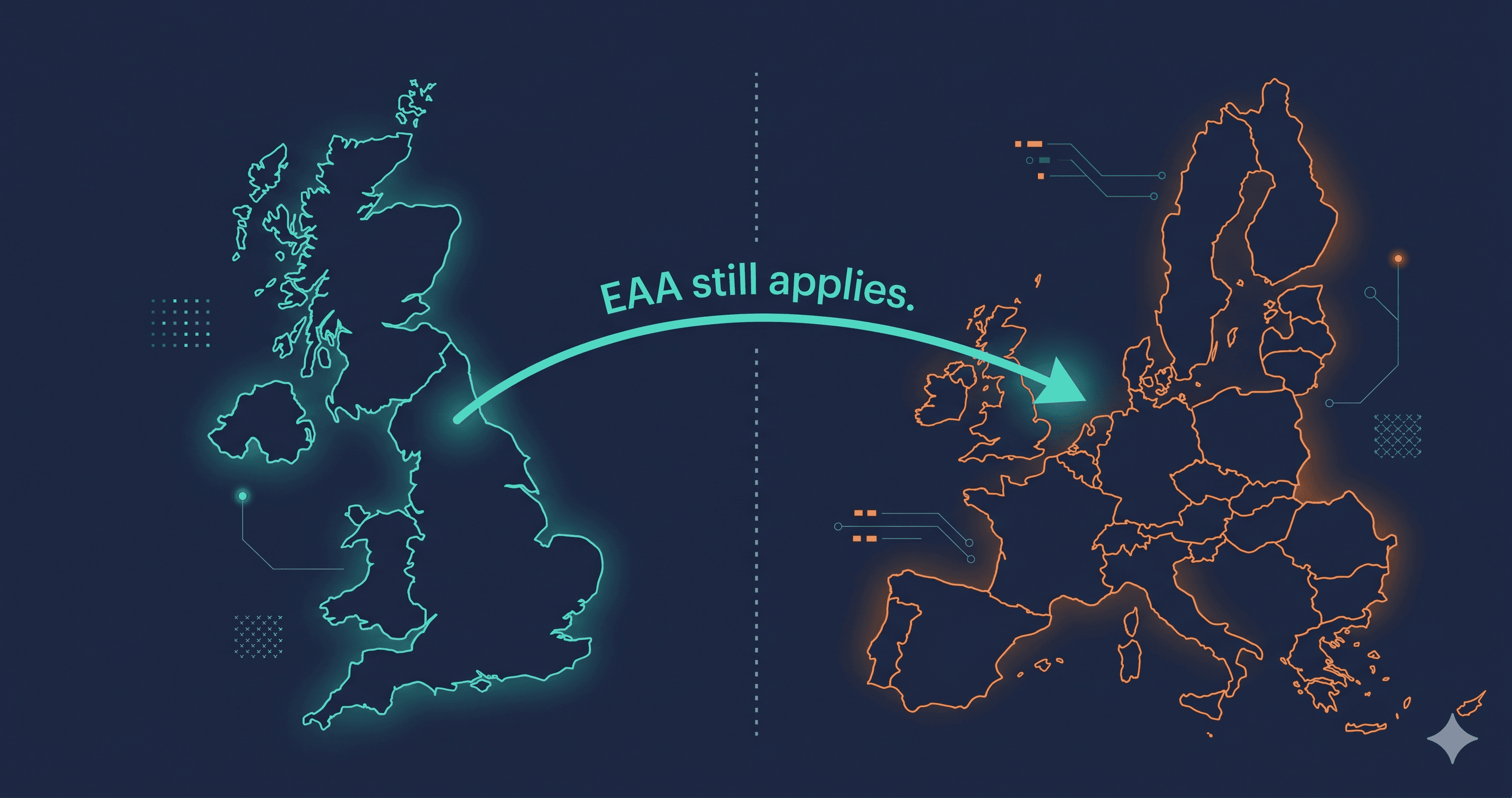
US companies routinely misread the EAA's geographic scope. The directive applies to any company selling covered products or services to EU consumers, regardless of where the company is headquartered. A Shopify merchant in Texas that ships to Germany is subject to BFSG. A SaaS company in New York with French subscribers is subject to French EAA enforcement. A DTC brand in California that sells into Spain faces Spain's three-tier fine structure.
The legal mechanism is market access. EU member states can prevent a non-compliant product or service from being offered in their market — which is a far more serious consequence than a US demand letter. Enforcement authorities don't need jurisdiction over your headquarters; they have jurisdiction over the market you're selling into.
What WCAG 2.1 AA Means in Practice for Both Laws
Both the ADA and EAA converge on WCAG 2.1 Level AA as the practical compliance standard. This means the same set of criteria govern both legal frameworks — but the emphasis differs.
Under the ADA, demand letters most frequently cite missing alt text on product images, unlabeled form inputs (especially in checkout), and keyboard navigation failures (particularly keyboard traps in modals and popups). These are the violations law firms scan for programmatically before filing.
Under the EAA, market surveillance authorities are more systematic. They apply EN 301 549 holistically — which means they look at the full user journey, including color contrast across all pages, video captions, document accessibility, and the accessibility of the checkout flow from first click to order confirmation.
The practical implication: fixing only the violations that appear in ADA demand letters may not be sufficient for EAA compliance. A full WCAG 2.1 AA audit against the live DOM — not just the HTML source — is the minimum starting point.
The ADA vs EAA Risk Calculation
If you have significant EU sales volume, you face both regimes simultaneously. Prioritizing them requires understanding your actual exposure:
The ADA is more likely to produce a demand letter in the near term, because US law firms scan millions of sites programmatically and send targeted demand letters. According to UsableNet, 4,800+ ADA lawsuits were filed in 2025 — a significant year-over-year increase. Serial plaintiff litigation has become a structured business model.
The EAA is more likely to produce a fine in the medium term, because national enforcement authorities are systematically building their audit programs. The Netherlands ACM, Sweden's PTS, and Germany's BAuA all launched formal enforcement programs in late 2025. Unlike demand letters, regulatory fines don't settle quietly — they're public records.
The right posture is to treat EAA and ADA compliance as a single program. They require the same underlying technical remediation (WCAG 2.1 AA). Separating them into two projects doubles your effort without doubling your protection.
What to Do When You Find Violations
When your scan report comes back with violations, they fall into two buckets: what your team can fix directly, and what requires vendor action.
Direct fixes include alt text on your own product images, color contrast ratios in your custom CSS, form labels in your checkout template, and focus indicators in your theme's stylesheet. These are changes your developer can make with specific WCAG criterion numbers from the scan report.
Vendor fixes are more complicated. If a keyboard trap exists in a third-party app — a chat widget, an email capture popup, a review widget — the fix requires a support ticket to that vendor with the specific WCAG criterion (e.g., "2.1.2 No Keyboard Trap") and a description of the failure. Vendors have varying response times and varying willingness to prioritize accessibility fixes. Documenting your outreach is important under both ADA and EAA — it demonstrates good faith compliance effort.
ADAGuard identifies both categories in its scan reports: violations in your own code versus violations introduced by third-party scripts. That distinction matters when you're having the conversation with a developer about what can be fixed today versus what requires vendor escalation.
The 30-Second Fix
The fastest way to understand your ADA and EAA exposure simultaneously is to run a single live-DOM scan of your store. ADAGuard's 23 check modules — 22 custom accessibility checkers plus axe-core — achieve approximately 78% WCAG 2.2 AA automated coverage, rendering JavaScript and checking the same page state a real user sees.
Scan your store free at adaguard.io. The report maps every violation to its specific WCAG criterion — the same criterion numbers referenced by US demand letters and EU enforcement frameworks. One scan, both regimes.
The ADA has been creating legal risk since 1990. The EAA added a second enforcement layer in June 2025. Most US merchants are only watching for one of them.