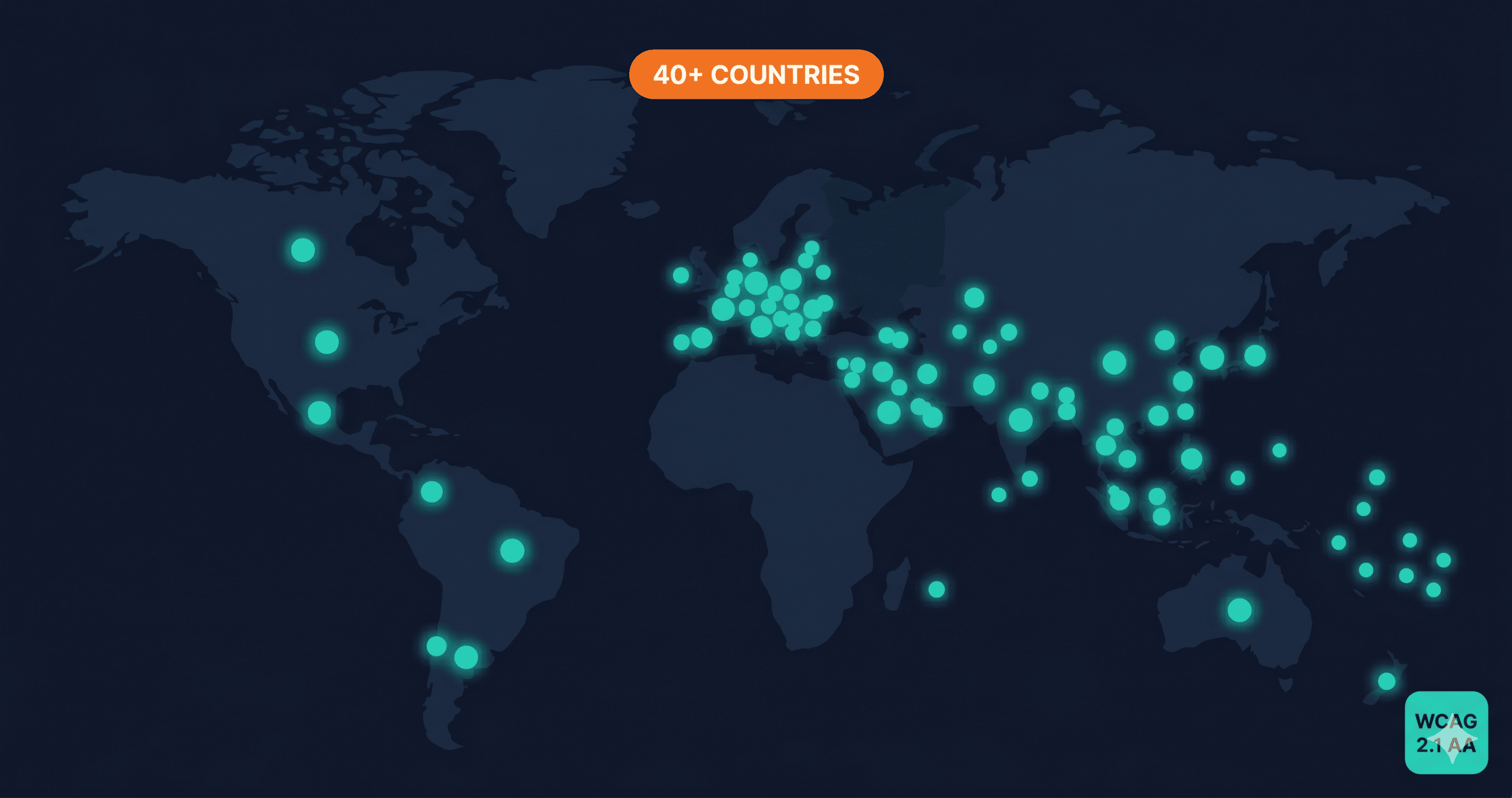
Your website may be violating accessibility laws in three countries simultaneously — and you may not know which three. Over 40 countries now have enforceable web accessibility requirements, and the list grew by more than a dozen nations between 2023 and 2026. The compliance question is no longer simply "does the ADA apply to me?" It's which of these 40+ laws apply, and are you meeting the standard each one demands?
According to W3C WAI, more than 50 countries now reference WCAG in their laws or policy frameworks. That is not a soft guidance figure — that's the count of jurisdictions where accessibility failures can trigger legal action, regulatory fines, or formal notices against your organisation.
Start with the law generating the most enforcement activity right now — our EAA compliance guide covers the requirement most likely to affect you.
Why the Landscape Changed So Quickly
For most of the 2010s, web accessibility law was primarily an American concern. The ADA (Americans with Disabilities Act) generated the most litigation, and businesses in Europe, Canada, and Australia treated accessibility as a public-sector obligation — government websites only.
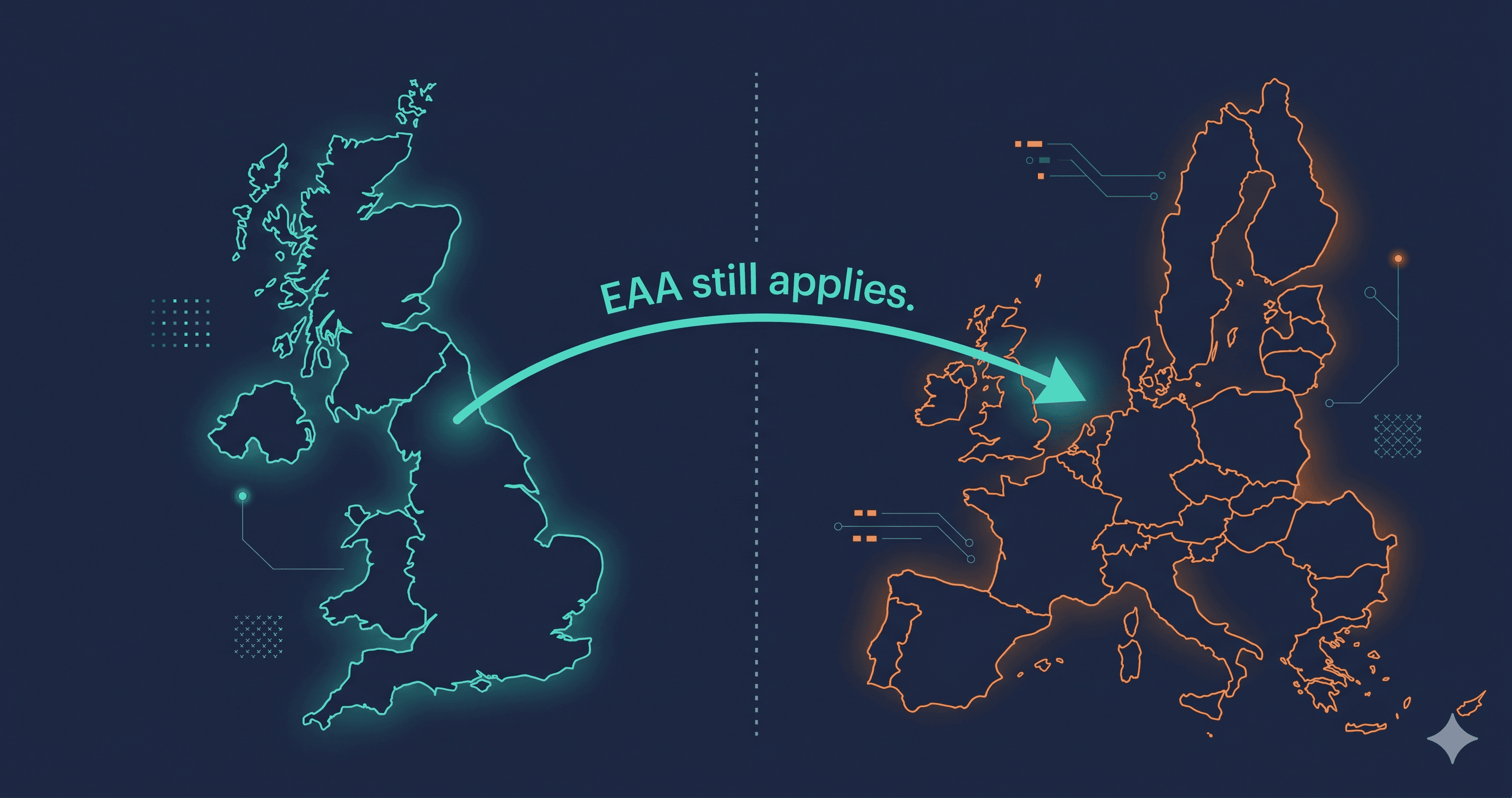
That changed decisively in 2025 when the European Accessibility Act (EAA) entered full enforcement on June 28, 2025. The EAA covers private companies — not just governments — across all 27 EU member states. It brought 450 million potential customers under a single harmonised accessibility framework, and it explicitly extends to any business selling into the EU, regardless of where that business is headquartered.
A US Shopify merchant shipping to Germany must comply. A UK SaaS company with French subscribers must comply. An Australian B2B platform with Italian enterprise clients must comply.
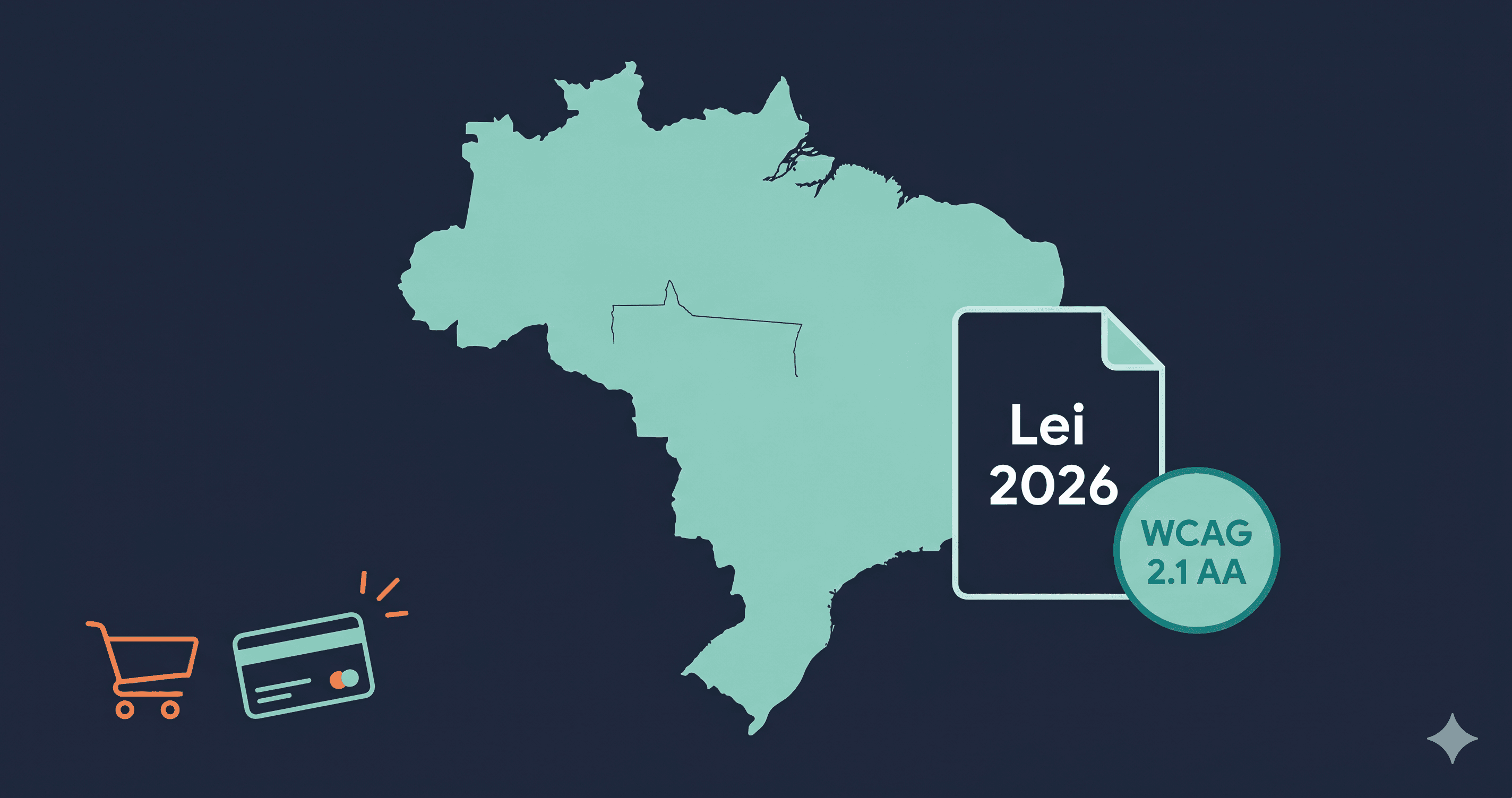
The same year, Brazil strengthened its Lei Brasileira de Inclusão (LBI) to explicitly cover e-commerce and digital banking. Canada intensified AODA enforcement in Ontario. And the US Department of Justice issued updated Title II guidance, setting WCAG 2.1 AA as the formal compliance standard for public-sector entities.
The cumulative effect: businesses that previously only had to worry about one jurisdiction's laws now routinely face overlapping obligations from two, three, or four legal frameworks simultaneously.
The 2026 Global Compliance Map
The table below summarises the key laws, standards, and enforcement approaches by region. This is not an exhaustive list — it covers the jurisdictions most likely to apply to English-language e-commerce, SaaS, and media businesses.
| Country / Region | Primary Law | WCAG Standard Required | Private Sector Covered? | Max Penalty |
|---|
| USA | ADA Title III | WCAG 2.1 AA (case law standard, no DOJ rule for private business) | Yes — via private lawsuits | $75K–$150K+ settlements |
| EU (27 states) | European Accessibility Act (EAA) | EN 301 549 = WCAG 2.1 AA | Yes — since June 28, 2025 | Up to €1M (Spain/Sweden) |
| UK | Equality Act 2010 | WCAG 2.1 AA (private benchmark) | Partial — growing case law | Compensation + compliance orders |
| Canada (Federal) | Accessible Canada Act | WCAG 2.1 AA | Federal entities only | Up to CAD $250,000 |
| Canada (Ontario) | AODA | WCAG 2.0 AA (upgrading to 2.1) | Yes — 50+ employees | Up to CAD $100,000/day |
| Australia | Disability Discrimination Act 1992 | WCAG 2.1 AA (benchmark) | Complaint-based | Settlements, compliance agreements |
| Brazil | Lei Brasileira de Inclusão (LBI) | WCAG 2.1 AA | Yes — e-commerce, fintech | Significant fines for financial sector |
| Israel | SI 5568 | WCAG 2.1 AA | Yes — broad private coverage | Regulatory fines |
| Germany | BFSG (transposition of EAA) | EN 301 549 / WCAG 2.1 AA | Yes — since June 28, 2025 | €100,000 per violation |
| France | EAA (national transposition) | EN 301 549 / WCAG 2.1 AA | Yes — enforcement underway | €250,000 (repeat) |
| Netherlands | EAA (national transposition) | EN 301 549 / WCAG 2.1 AA | Yes — highest EU penalty | €900,000 or 1–10% turnover |
| Spain | EAA (national transposition) | EN 301 549 / WCAG 2.1 AA | Yes — immediate penalties | €1,000,000 (very serious) |
The critical insight this table reveals: WCAG 2.1 AA is the near-universal global baseline. If you build to WCAG 2.1 AA, you satisfy the technical standard in the US, EU, UK, Canada, Australia, Brazil, and most other markets simultaneously. Conversely, if you fail WCAG 2.1 AA, you are out of compliance across all of these jurisdictions at once.
What the US Enforcement Picture Looks Like in 2026
The ADA remains the most active source of web accessibility litigation globally. In 2025, 4,800+ web accessibility lawsuits were filed in the United States, representing a significant year-over-year increase, according to UsableNet's 2025 mid-year report. Serial plaintiffs and plaintiff law firms have become increasingly systematic, targeting e-commerce checkouts, image alt text failures, and inaccessible popups and modals.
The distinction from EU enforcement is the mechanism: US litigation is plaintiff-driven, with no government agency actively auditing private websites. In the EU, national regulatory agencies are doing the auditing — and issuing formal notices to businesses that didn't know they were being watched.
What EAA Enforcement Actually Looks Like (It's Not a Fine — Yet)
As of May 2026, no formal EAA financial penalty has been publicly imposed. What has happened:
- France: Formal legal notices were served on Carrefour, Auchan, E. Leclerc, and Picard Surgelés in July 2025. Emergency injunctions were filed in November 2025. Cases remain pending.
- Germany: Private Abmahnungen (warning letters from competitors invoking the UWG unfair competition law) began arriving in August 2025, within weeks of the BFSG taking effect.
- Netherlands: The ACM (Authority for Consumers and Markets) issued mandatory reporting requirements beginning October 2025.
The pattern mirrors how GDPR enforcement unfolded — a period of notices and guidance, followed by escalating regulatory action as agencies develop their enforcement infrastructure. The fines in the table above represent the statutory maximum once formal enforcement mechanisms mature.
The WCAG Version Problem
One complexity the table above doesn't fully capture: WCAG version requirements differ slightly across jurisdictions, and the standard is still moving.
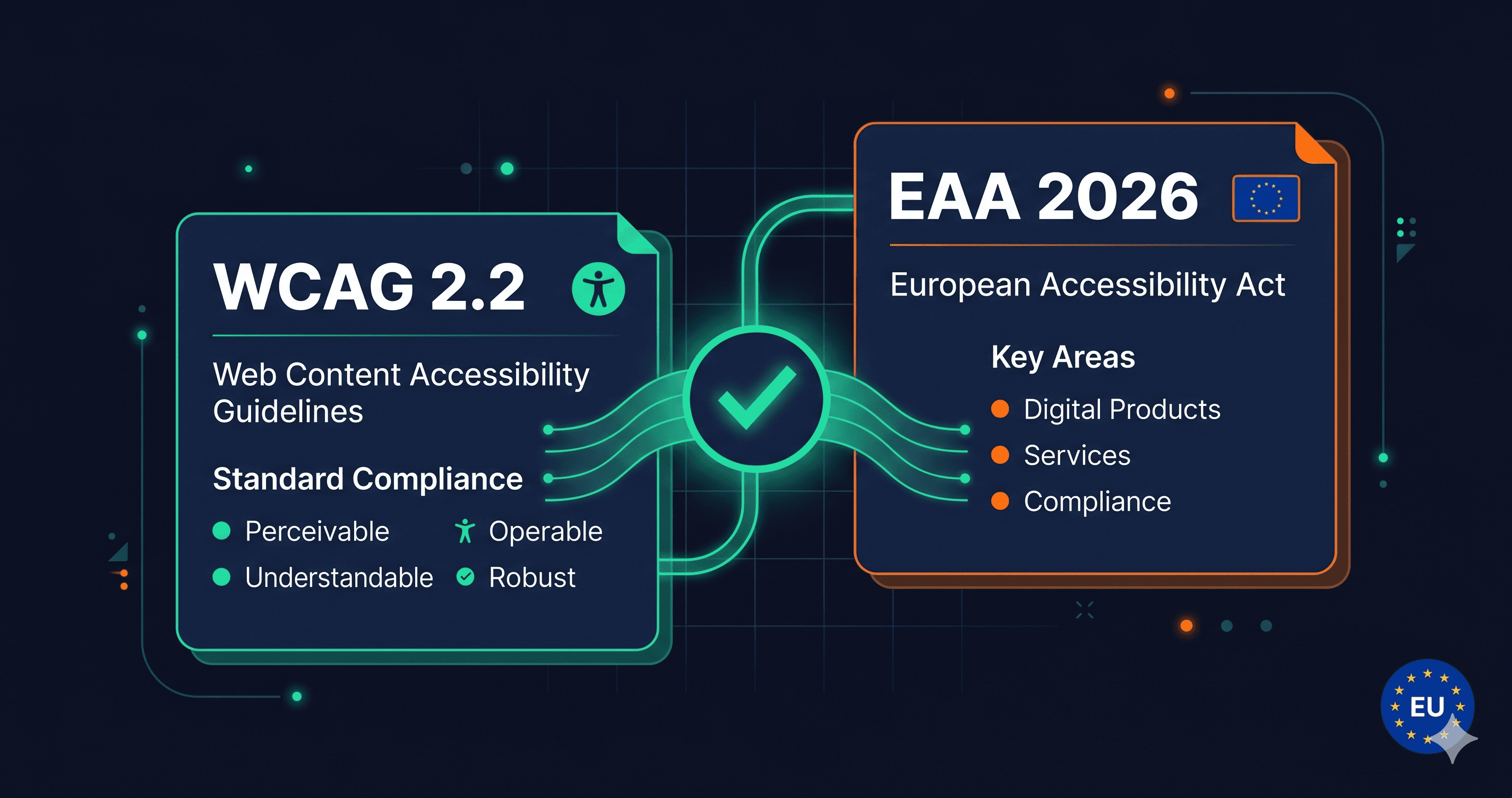
The current EU standard (EN 301 549 v3.2.1) references WCAG 2.1 AA. An updated version incorporating WCAG 2.2 — called EN 301 549 v4.1.1 — is expected in 2026. Once published in the EU Official Journal, it will become the binding technical standard for EAA compliance. WCAG 2.2 added nine new success criteria, notably around keyboard navigation, accessible authentication, and focus visibility. None of the WCAG 2.1 criteria were removed — so meeting 2.2 means meeting 2.1 plus the new requirements.
The strategic implication: if you are building or auditing for EAA compliance today, target WCAG 2.2 AA rather than 2.1. It future-proofs your audit and satisfies the stricter UK public sector standard simultaneously.
Why Static Scanners Cannot Satisfy Multi-Jurisdiction Compliance
Most website accessibility checkers evaluate your site's static HTML — what's in the page source at load time. But JavaScript-rendered content, dynamic modals, authenticated checkout flows, and interactive widgets are invisible to static scanners.
This matters in the global compliance context because the most-cited violations in EAA notices and ADA lawsuits involve interactive elements: inaccessible screen reader flows through checkout, keyboard traps in popups, and unlabelled form fields that only appear after JavaScript execution. These are not detectable without a scanner that actually renders the page the way a browser and assistive technology would.
ADAGuard scans your live DOM — JavaScript rendered, fully interactive — against 22 custom accessibility checker modules plus axe-core integration. That gives approximately 78% WCAG 2.2 AA automated coverage (43 of 55 criteria). For businesses navigating multi-jurisdiction compliance in 2026, coverage gaps are not acceptable.
ADAGuard's reports are structured around WCAG criterion numbers — exactly the format regulators and lawyers reference in notices and filings. When a French regulator cites failure of WCAG 2.1 criterion 1.1.1, your ADAGuard report tells you precisely which elements triggered that failure on your live site.
What This Means Practically for an International Business
If you operate in the US and sell into the EU — even occasionally — you are subject to both ADA litigation risk and EAA regulatory risk simultaneously. Your compliance exposure is additive, not alternative.
The good news is that a single technical standard — WCAG 2.2 AA — satisfies both. One thorough accessibility audit, correcting the failures it identifies, materially reduces your exposure across all 40+ jurisdictions. The audit needs to cover your live site, including authenticated pages, checkout flows, and JavaScript-rendered elements.
The bad news is that most businesses have never run that audit. Many assume their off-the-shelf platform (Shopify, WordPress, BigCommerce) handles accessibility automatically. It does not. Platform accessibility compliance governs the theme framework — not the third-party apps, widgets, popups, and custom code you've added to it.
The 30-Second Fix
Go to adaguard.io, paste your URL, and run a free scan. No account required. The report will show you which WCAG 2.2 AA criteria you currently fail, with the criterion numbers your legal team and any regulatory correspondence will reference. It covers your live DOM, not just static HTML — which means you'll see the violations that automated tools and static scanners miss.
Over 40 countries now have a legal stake in your site's accessibility. Find out where you stand before a regulator, a competitor, or a plaintiff's attorney does it for you.